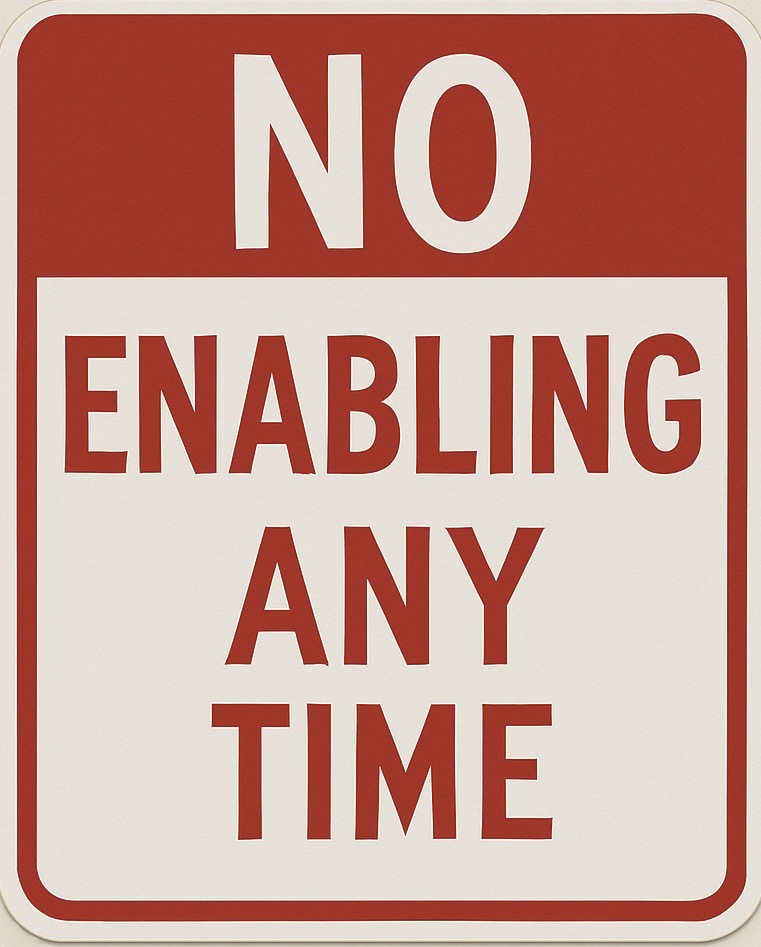

Boundaries vs. Threats: Why One Protects You and One Just Prolongs the Pain
Learn the difference between a boundary and a threat when a loved one struggles with addiction — and why one protects you while the other prolongs the pain.
Direct answer
How do I know if I am helping or enabling?
Helping supports responsibility, truth, treatment, and repair. Enabling protects addiction from consequences, usually through money, excuses, housing, secrecy, or emotional rescue.
Reviewed through Matt Brown's family intervention and coaching lens.
Open full answer →Why this is here
Families rarely need more pressure. They need clearer patterns, steadier boundaries, and a next step they can actually hold.
Written from intervention experience
This article is part of No More Enabling’s family education library, shaped by Matt Brown’s work with families affected by addiction, treatment resistance, relapse, and boundary breakdowns since 2004.
Author and editorial reviewer: Matt Brown, professional interventionist and family addiction coach. Medical claims require separate qualified clinical review.
Read this as part of a bigger pattern
If this article hits home, these guided hubs will help you keep reading in a smarter order instead of starting from scratch each time.
Adult Child Addiction Hub
Best when you are asking how to stay loving without becoming the safety net for active addiction.
Open hub →
Financial Enabling Hub
Best when you need to help without becoming the financial safety net that keeps the addiction cycle alive.
Open hub →
Treatment Resistance Hub
Best when conversations about treatment keep failing and the family needs a calmer, more structured next move.
Open hub →
If this article sounds like your family
Do this next
When safety is involved, the next step should be clear and proportionate. Start with the crisis and safety path before another conversation.
Next best step
Choose your next step
If this article sounds like your family, use the short assessment to route the situation before the next hard conversation.
When your family needs a real plan
Coaching and intervention guidance with Matt Brown
If articles are helping but the situation at home is still escalating, you can ask for direct help with family alignment, boundaries, treatment refusal, relapse patterns, or deciding whether an intervention makes sense.
High-intent next step
Family addiction coaching with Matt Brown for enabling and boundaries
Get private family addiction coaching from Matt Brown for enabling, boundaries, treatment refusal, relapse, money decisions, and a clear next step.

If you have ever said "If you use again, I'm done" — and then weren't — you already know the difference between a boundary and a threat, even if no one ever named it for you. You meant it when you said it. You were exhausted, scared, and desperate for something to change. And then the moment came, and you stayed. And they used that. And you felt more stuck than before.
This isn't a character flaw. It's what happens when we confuse two very different things: the difference between a boundary and a threat in addiction. Most families of people struggling with addiction have issued dozens of threats while setting almost no actual limits. They look the same from the outside. They feel completely different on the inside — and they produce completely different results.
Understanding the distinction is one of the most important things a family member can do. Not because limits magically fix the person you love — they don't. But because this clarity might be the first thing that actually protects you.
What Is a Boundary, Really?
A boundary is something you control. It is a decision about your own behavior, not a condition you place on someone else's. When you set a real limit, you are drawing a line around yourself — not around them.
A real limit sounds like this: "I won't drive you anywhere when you've been drinking." Not: "You had better not drink if you expect me to drive you." The first one is entirely in your hands. The second one depends on what they do next.
Real limits are grounded in your values, your capacity, and your safety. They are not reactions — they are decisions you've thought through in advance. You know what you will do. And when the moment comes, you do it, regardless of how they respond, what they say, or whether they are angry.
That last part is why limits are so hard for families dealing with addiction. The person you love will often escalate when you hold a limit. They may cry, rage, or disappear for days. Holding the limit anyway — not as punishment, but as self-protection — is the work.
What Is a Threat?
A threat is a conditional statement directed at someone else's behavior. It is designed to change what they do through fear of consequences. The problem: you can only enforce it if they do the thing you are trying to prevent — and by then, you are already in the situation you were trying to avoid.
Threats in the context of addiction often sound like this:
- "If you miss one more family dinner, I'm not coming to your graduation."
- "If you don't go to treatment this week, I'm cutting you off completely."
- "If I find out you used again, I'm telling your father."
None of these feelings are wrong. They come from a place of real pain and real love. But they are all based on what the other person does. And here is the hard truth about addiction: the person you love may not be able to change their behavior on the basis of your threat, no matter how much they want to. The disease does not negotiate.
So what happens? They use again. You issue the threat. And then you face the choice: follow through on something you said in desperation — or back down and watch your words lose all meaning. Most families back down. And the cycle deepens.
Why Threats Don't Work With Addicted Loved Ones
Threats assume the other person has sufficient control over their behavior to respond to consequences. That assumption breaks down with active addiction. It is not that your loved one doesn't care. It is that addiction hijacks the decision-making centers of the brain. Repeated exposure to substances fundamentally changes how the brain processes reward, consequence, and choice.
This does not mean your loved one has zero agency — they do. Recovery is real and people achieve it every day. But a threat from a family member, no matter how heartfelt, is rarely the lever that moves someone from active addiction into treatment. More often, it produces shame. And shame, in addiction, tends to drive more using.
There is also a secondary effect: threats that are not followed through on teach the addicted person that your words do not match your actions. Every empty ultimatum makes the next one easier to ignore. Over time, your leverage erodes completely. Not because you are weak, but because the tool was the wrong one for the job.
How to Tell the Difference in Your Own Life
The easiest way to know whether you are setting a real limit or issuing a threat is to ask yourself one question: "Is this something I can actually carry out — regardless of what they do?"
If the answer is yes, and you have decided you will, that is a limit. If the answer depends on what they do next, it is a threat.
Here is a side-by-side look at how the same situation can go two different ways:
Threat version
"If you don't call the treatment center by Friday, I am going to stop paying your phone bill." This is contingent on their action. If Friday comes and they don't call, you now have to decide whether to follow through. The weight of the entire situation rests on them.
Limit version
"I have decided I am not going to keep paying your phone bill. That is a decision I am making about my finances and what I am able to sustain right now." This has nothing to do with Friday or treatment centers. It is something you have decided for yourself, and it is already done.
You can still offer: "When you are ready to explore treatment, I want to help you with that." That is not a threat — that is an open door. The limit and the love can coexist.
Setting Limits That Actually Hold
You do not have to overhaul everything at once. In fact, trying to set twenty limits at the same time is a reliable way to set none of them. Start small.
Choose one area of your life where you feel consistently drained, resentful, or unsafe. That is usually where a real limit is most needed. Then ask yourself: what is one thing I can commit to — and actually do — that protects me in that area?
Write it down. Not as a condition. As a commitment to yourself.
It might be: "I won't answer the phone after 10 p.m." Or: "I won't cover for missed work calls." Or: "I won't remain in the house when there is active using." These are yours. They do not require negotiation, permission, or agreement from your loved one.
Will they push back? Almost certainly. That is not a sign you have done something wrong — it is often a sign you have done something right. Real limits create friction at first, because they represent a change in a system your loved one has come to rely on.
Hold it anyway. Not to punish. Not to win. To protect yourself — and to show, maybe for the first time, that your words mean something.
You Cannot Control the Addiction. You Can Control This.
You did not cause this. You cannot cure it. You cannot control it — those three C's come from Al-Anon and they are worth writing somewhere visible. But you can control what you do. You can control how you spend your energy, your money, and your emotional reserves. You can control whether your words carry weight.
Understanding the difference between a boundary and a threat in addiction is not about becoming cold or giving up on the person you love. It is about becoming someone whose love is actually sustainable. Threats come from desperation. Limits come from clarity. Clarity is something you can build — one small, honest decision at a time.
If you are ready to get clearer on what limits look like in your specific situation, the coaches at SoberHelpline.com work with family members every day to help them move from exhaustion into something more solid. And if you are at the point where a professional intervention may be the next right step, FreedomInterventions.com is a good place to start that conversation.
Frequently Asked Questions
What is the difference between a boundary and a threat in addiction?
A boundary is a decision you make about your own behavior — something entirely within your control. A threat is a conditional statement aimed at changing someone else's behavior. Real limits are grounded in your values and you can follow through regardless of what your loved one does. Threats depend on their actions, and when they are not followed through on, they lose all credibility.
Why do threats stop working with someone who is addicted?
Addiction affects the brain's ability to process consequences the same way a non-addicted brain does. Your loved one may genuinely want to change but be unable to do so purely in response to a threatened consequence. Repeated empty ultimatums also teach the addicted person that your words do not carry weight, which makes future limits even harder to hold.
Can I set a limit without ending the relationship?
Yes. Most real limits are about specific behaviors or situations, not the relationship itself. Not giving money, not covering for missed commitments, or not being available late at night are all limits that protect you while keeping the relationship intact. A limit is not a rejection — it is a decision about what you can and cannot sustain.
What if my loved one says I am being cruel when I hold a limit?
That reaction is common, and it does not mean you have done something wrong. When a system changes — even in a healthy direction — the people in it often push back. Your loved one may feel threatened by a limit that closes off a pattern they have relied on. Hold it anyway. You can be kind and firm at the same time.
How do I know if I am ready to set a real limit?
Start with limits you can actually follow through on. If you are not sure you can hold it, it is not ready yet. A smaller limit you actually keep is more powerful than a large one you abandon. Clarity matters more than intensity — choose one thing, decide it fully, and hold it.
Should I tell my loved one I am setting a limit?
Sometimes yes, sometimes no — it depends on the limit. Some limits require communication ("I won't be lending you money going forward"). Others are simply decisions you make without announcement ("I'll start going to Al-Anon"). The limit belongs to you. You are not obligated to justify it, though calmly stating it when relevant can reduce confusion.
Free family tool
Financial Boundaries Script
A short script for saying no to cash, rent, bills, and last-minute rescue requests without getting pulled into another negotiation.
This does not replace the Family Squares meeting. It gives you a practical tool first, then points you toward the live support room if you need help using it.
Get weekly guidance for families dealing with boundaries
Every Sunday, one short email with practical family guidance on boundaries, enabling, relapse, and next steps.
"Practical, not preachy. It reads like someone who has actually sat with families instead of a wellness blog."
— Sister of a brother in relapse
Trust signals
Source-worthy public resources
These links are not a substitute for medical, legal, or crisis care. They are included to help families verify safety and treatment information from official sources.
Next best answers
If this is what you were really asking
How do I stop enabling without abandoning someone I love?
Stop doing what protects the addiction, but stay available for recovery-supporting action. The goal is not less love. The goal is cleaner support.
Open answer →
What if the other house is running a different plan?
Two houses. One disease. If one parent pays rent and the other hands over the keys, nothing holds. Money, housing, and contact have to be the same line in both kitchens. You cannot control the other house. You can stop being the second rescue.
Open answer →
How do I know if I am helping or enabling?
Helping supports responsibility, truth, treatment, and repair. Enabling protects addiction from consequences, usually through money, excuses, housing, secrecy, or emotional rescue.
Open answer →
What should I do when an addicted loved one breaks a boundary?
Do not renegotiate the boundary in the heat of the moment. Follow through calmly, document the pattern, and review whether the boundary was specific enough to hold.
Open answer →
Need a steadier next step?
Don’t stop at insight
The families who make progress usually do three things: they get honest about the pattern, choose one clearer next step, and stop trying to manage everything at once.
Helping or Enabling? Tool
Best when you keep second-guessing what support should look like.
Family Support Guide
Best when everything feels heavy, urgent, or emotionally scrambled.
Free Boundaries Course
Best when your limits keep getting negotiated away under pressure.
About Matt Brown and this site
Understand the experience and point of view behind the guidance here.

FamilyBridge
AI support for families across the recovery journey.