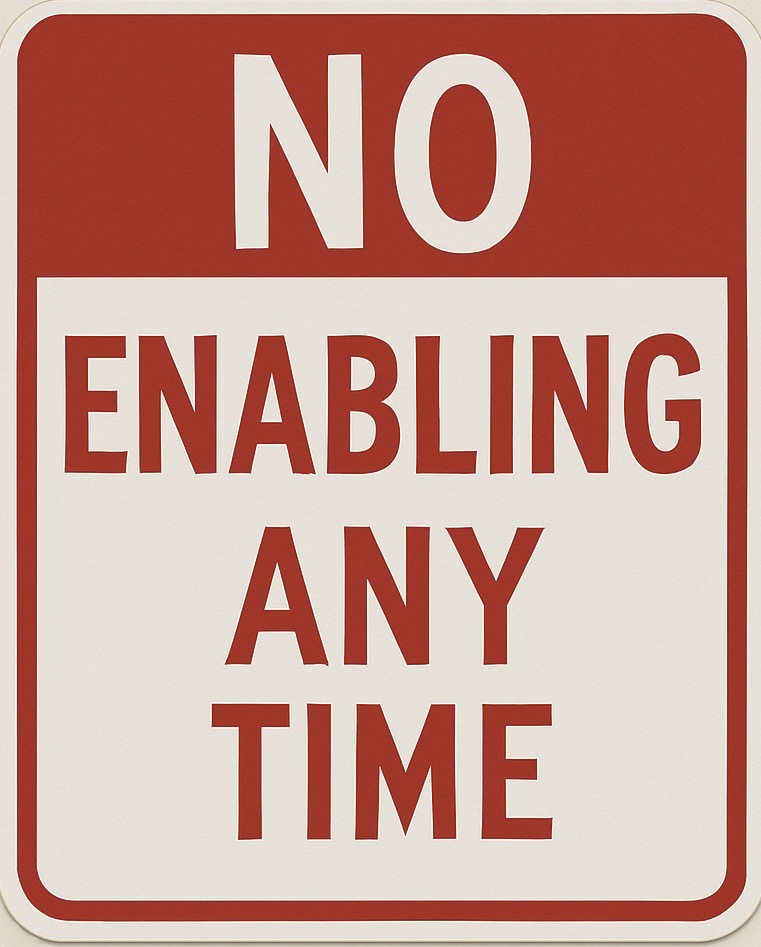

Why Boundaries Actually Protect Your Addicted Loved One — Not Just You
Healthy boundaries with an addicted loved one don't just protect you — they protect them too. Here's why limits are one of the most loving things a family can offer.
Direct answer
How do I know if I am helping or enabling?
Helping supports responsibility, truth, treatment, and repair. Enabling protects addiction from consequences, usually through money, excuses, housing, secrecy, or emotional rescue.
Reviewed through Matt Brown's family intervention and coaching lens.
Open full answer →Why this is here
Families rarely need more pressure. They need clearer patterns, steadier boundaries, and a next step they can actually hold.
Written from intervention experience
This article is part of No More Enabling’s family education library, shaped by Matt Brown’s work with families affected by addiction, treatment resistance, relapse, and boundary breakdowns since 2004.
Author and editorial reviewer: Matt Brown, professional interventionist and family addiction coach. Medical claims require separate qualified clinical review.
Read this as part of a bigger pattern
If this article hits home, these guided hubs will help you keep reading in a smarter order instead of starting from scratch each time.
Adult Child Addiction Hub
Best when you are asking how to stay loving without becoming the safety net for active addiction.
Open hub →
Financial Enabling Hub
Best when you need to help without becoming the financial safety net that keeps the addiction cycle alive.
Open hub →
Treatment Resistance Hub
Best when conversations about treatment keep failing and the family needs a calmer, more structured next move.
Open hub →
If this article sounds like your family
Do this next
If the real issue is holding the line, don’t stop at reading. Work through the boundaries course next.
Next best step
Choose your next step
If this article sounds like your family, use the short assessment to route the situation before the next hard conversation.
When your family needs a real plan
Coaching and intervention guidance with Matt Brown
If articles are helping but the situation at home is still escalating, you can ask for direct help with family alignment, boundaries, treatment refusal, relapse patterns, or deciding whether an intervention makes sense.
High-intent next step
Family addiction coaching with Matt Brown for enabling and boundaries
Get private family addiction coaching from Matt Brown for enabling, boundaries, treatment refusal, relapse, money decisions, and a clear next step.
If you've ever tried to set a boundary with someone you love who is struggling with addiction, you know what the voice in your head sounds like:
"What if they get hurt? What if they go somewhere dangerous? What if this is the push that makes things worse?"
That voice isn't weakness. It's love — real, bone-deep love — working with incomplete information.
Here's what that voice doesn't know yet: healthy boundaries don't just protect you. They protect your loved one, too. In fact, the absence of boundaries is one of the most reliable ways to keep someone locked inside an addiction longer than they need to be.
This isn't blame. It isn't a lecture. It's the part of the conversation most families never hear — and the part that can actually change things.
What Does a Boundary Actually Do?
A boundary is not a wall you build to keep someone out. It's a line that defines what you will and won't participate in — and it signals to your loved one what reality actually looks like.
Addiction survives on two things: the substance itself, and a managed environment where consequences stay small or disappear entirely. Every time a family member covers rent, calls in sick on someone's behalf, or stays quiet to keep the peace, that environment gets a little more comfortable — and a little easier to stay in.
A boundary interrupts that comfort. Not harshly, not as punishment. But clearly. "I won't pay for the car insurance this month" is not cruelty. It's information. It says: the way things have been going cannot keep going this way.
Your loved one may not hear it as that at first. They may hear it as rejection. That's expected. The goal isn't a smooth conversation — it's an honest one.
How Removing Consequences Delays Recovery
Consequences are the mechanism by which most people recognize a problem and decide to do something about it. This is as true for addiction as it is for anything else in life.
When families soften or eliminate consequences — even from the most loving instinct — they inadvertently delay the moment their loved one reaches what's often called a 'bottom': the point where the cost of continuing becomes undeniable.
There is no magic bottom. It's not a fixed place. It moves based on what the environment allows. Families have the ability — not the responsibility, but the ability — to raise that floor. To say: this is where we stop absorbing the fallout, and this is where you start feeling it.
That moment, as painful as it is to watch, is often the exact moment things start to shift.
Why Boundaries Feel Like Abandonment (and Why They Aren't)
One of the most common fears families carry is this: if I stop doing what I've been doing, my loved one will feel abandoned.
It's a fair fear. And your loved one may even say exactly that — "you've given up on me" — when you stop covering for them or funding their choices. Addiction is skilled at that kind of argument.
But here's the difference between abandonment and a boundary:
- Abandonment is withdrawing love, presence, and care.
- A boundary is withdrawing participation in behaviors that are causing harm.
You can hold a firm limit and still say, "I love you. I want you to get better. I'm not willing to keep doing this, but I'm not leaving." That's not abandonment. That's one of the most honest, loving things you can say to someone who is struggling.
Recovery programs have a phrase for this: detach with love. It means staying emotionally present without staying behaviorally enmeshed. It is harder than it sounds. It is also possible.
What Boundaries Look Like in Practice
Healthy boundaries with an addicted loved one are specific, behavioral, and calm. They describe what you will do — not what you're demanding they do.
The difference matters:
- "You need to get sober" is a demand. It may be true, but it gives them something to push back against.
- "I won't have you in my home when you've been drinking" is a boundary. It describes your behavior, not theirs.
Other examples of protective boundaries:
- "I won't lie to your employer about why you missed work."
- "I won't give you money directly, but I'm willing to pay your doctor's bill."
- "I won't attend family dinners if they turn into arguments about your use."
- "I love you, and I'm not willing to watch this happen without you getting some kind of help. That's my limit."
None of these are ultimatums designed to punish. They're honest statements about what you can and can't be part of. Said calmly, clearly, and consistently — they carry weight. Said in anger or withdrawn the next day — they carry almost none.
The consistency is the boundary. It's not a speech. It's a pattern.
The Protective Gift You May Not See Yet
This is hard to hold onto when you're in the middle of it — but it's true:
When you stop enabling, you give your loved one back something they lost: the full weight of their own choices.
That weight is uncomfortable. Sometimes it's devastating. But it is also the thing that creates movement. Humans change when the cost of staying the same becomes higher than the cost of changing. When families absorb that cost on their behalf, change has no reason to come.
This doesn't mean it's your fault for helping. It means that help, applied in the wrong direction for too long, can work against the person you love.
Setting limits — real ones, followed through on — is a form of hope. It says: I believe you are capable of facing this. I'm not going to manage it away for you.
You Don't Have to Be Perfect at This
Boundaries aren't a one-time conversation. They're a practice. You'll probably slip. You'll soften them when your loved one is suffering, or firm them up when you're angry and then feel guilty about it. That's normal.
The goal isn't perfection — it's direction. Moving, slowly and imperfectly, toward a version of your relationship that doesn't require you to disappear so that your loved one doesn't have to feel anything.
You deserve that. And honestly? So do they.
If you're not sure where to start, or you've been trying to hold limits on your own and keep losing ground, you don't have to do this alone. SoberHelpline.com offers family coaching and education designed for exactly this situation. And if your loved one is at a point where a professional intervention may be what's needed, FreedomInterventions.com is a safe place to explore that option.
Frequently Asked Questions
Do boundaries actually help an addicted loved one get sober?
Boundaries don't force sobriety — nothing does. But they do remove the cushion that makes staying in active addiction more comfortable. When natural consequences are allowed to occur, the motivation to seek help often increases. Most people in long-term recovery point to a moment when the cost of continuing became undeniable — and family limits frequently play a role in that moment.
What is the difference between a boundary and a punishment?
A boundary describes what you will or won't participate in, regardless of what your loved one does. A punishment is a consequence you impose to make them pay for a choice. Boundaries are about your behavior; punishments are about controlling theirs. Boundaries protect the relationship. Punishments usually damage it.
My loved one says my boundaries are cruel. Are they right?
It's common for people in active addiction to reframe limits as attacks. That's not usually dishonesty — it's how addiction thinks. A boundary that is calm, consistent, and not designed to shame is not cruel. The fact that it causes discomfort doesn't make it unkind. Discomfort is often what drives change.
Can boundaries backfire and make things worse?
Boundaries set in anger, withdrawn under pressure, or delivered as threats can backfire. Boundaries held calmly and consistently rarely make things worse in the long run — even if the short-term reaction is painful. If you're unsure how to approach this in your specific situation, a family coach or counselor can help you calibrate.
How do I set a boundary without starting a fight?
Choose a calm moment — not in the middle of a crisis or argument. Keep your language simple and behavioral: say what you will or won't do, not what they need to do. Avoid long explanations or negotiations. The shorter and clearer the statement, the harder it is to argue with. You don't need their agreement — you just need to mean it.
What if I've already tried setting limits and they didn't work?
Most families try limits at least once before they hold. If they weren't followed through on, or were set in a way that invited debate, that's a reset — not a failure. What matters is what you do next. Working with a family coach or counselor can help you understand what happened and how to approach it differently.
Free family tool
Financial Boundaries Script
A short script for saying no to cash, rent, bills, and last-minute rescue requests without getting pulled into another negotiation.
This does not replace the Family Squares meeting. It gives you a practical tool first, then points you toward the live support room if you need help using it.
Get weekly guidance for families dealing with boundaries
Every Sunday, one short email with practical family guidance on boundaries, enabling, relapse, and next steps.
"Practical, not preachy. It reads like someone who has actually sat with families instead of a wellness blog."
— Sister of a brother in relapse
Trust signals
Source-worthy public resources
These links are not a substitute for medical, legal, or crisis care. They are included to help families verify safety and treatment information from official sources.
Next best answers
If this is what you were really asking
How do I stop enabling without abandoning someone I love?
Stop doing what protects the addiction, but stay available for recovery-supporting action. The goal is not less love. The goal is cleaner support.
Open answer →
What if the other house is running a different plan?
Two houses. One disease. If one parent pays rent and the other hands over the keys, nothing holds. Money, housing, and contact have to be the same line in both kitchens. You cannot control the other house. You can stop being the second rescue.
Open answer →
How do I know if I am helping or enabling?
Helping supports responsibility, truth, treatment, and repair. Enabling protects addiction from consequences, usually through money, excuses, housing, secrecy, or emotional rescue.
Open answer →
What should I do when an addicted loved one breaks a boundary?
Do not renegotiate the boundary in the heat of the moment. Follow through calmly, document the pattern, and review whether the boundary was specific enough to hold.
Open answer →
Need a steadier next step?
Don’t stop at insight
The families who make progress usually do three things: they get honest about the pattern, choose one clearer next step, and stop trying to manage everything at once.
Helping or Enabling? Tool
Best when you keep second-guessing what support should look like.
Family Support Guide
Best when everything feels heavy, urgent, or emotionally scrambled.
Free Boundaries Course
Best when your limits keep getting negotiated away under pressure.
About Matt Brown and this site
Understand the experience and point of view behind the guidance here.

FamilyBridge
AI support for families across the recovery journey.