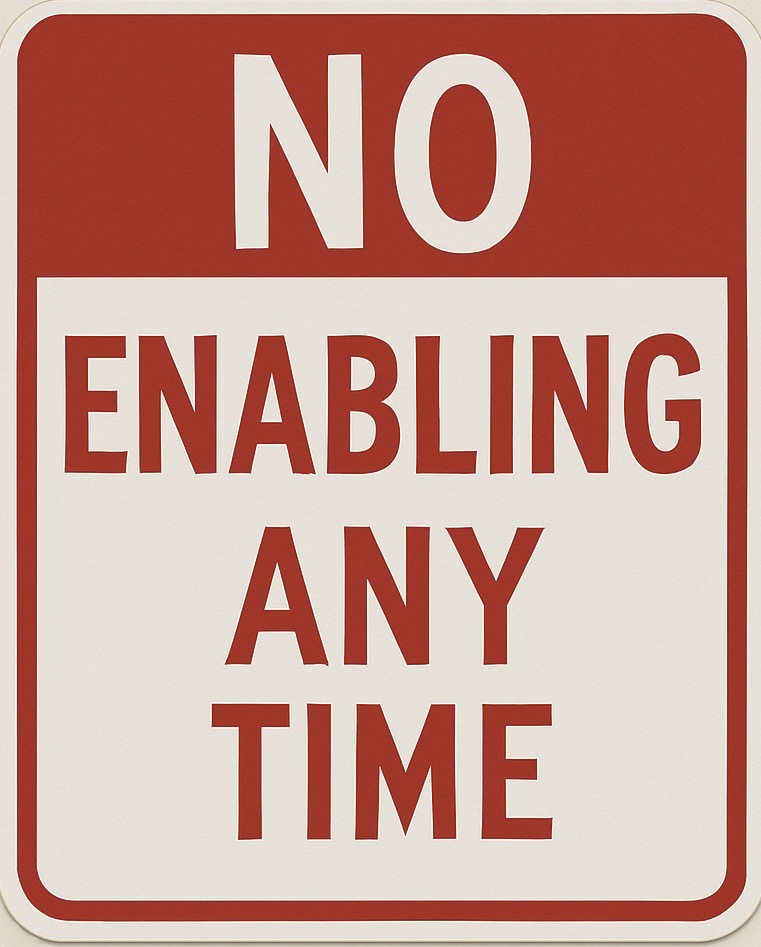

How to Set a Boundary When You've Been Enabling for Years
If you've been enabling for years, setting a new boundary feels impossible. Here's how to do it clearly, calmly, and without blowing everything up.
Direct answer
How do I know if I am helping or enabling?
Helping supports responsibility, truth, treatment, and repair. Enabling protects addiction from consequences, usually through money, excuses, housing, secrecy, or emotional rescue.
Reviewed through Matt Brown's family intervention and coaching lens.
Open full answer →Why this is here
Families rarely need more pressure. They need clearer patterns, steadier boundaries, and a next step they can actually hold.
Written from intervention experience
This article is part of No More Enabling’s family education library, shaped by Matt Brown’s work with families affected by addiction, treatment resistance, relapse, and boundary breakdowns since 2004.
Author and editorial reviewer: Matt Brown, professional interventionist and family addiction coach. Medical claims require separate qualified clinical review.
Read this as part of a bigger pattern
If this article hits home, these guided hubs will help you keep reading in a smarter order instead of starting from scratch each time.
Adult Child Addiction Hub
Best when you are asking how to stay loving without becoming the safety net for active addiction.
Open hub →
Financial Enabling Hub
Best when you need to help without becoming the financial safety net that keeps the addiction cycle alive.
Open hub →
Treatment Resistance Hub
Best when conversations about treatment keep failing and the family needs a calmer, more structured next move.
Open hub →
If this article sounds like your family
Do this next
If the real issue is holding the line, don’t stop at reading. Work through the boundaries course next.
Next best step
Choose your next step
If this article sounds like your family, use the short assessment to route the situation before the next hard conversation.
When your family needs a real plan
Coaching and intervention guidance with Matt Brown
If articles are helping but the situation at home is still escalating, you can ask for direct help with family alignment, boundaries, treatment refusal, relapse patterns, or deciding whether an intervention makes sense.
High-intent next step
Family addiction coaching with Matt Brown for enabling and boundaries
Get private family addiction coaching from Matt Brown for enabling, boundaries, treatment refusal, relapse, money decisions, and a clear next step.

You didn't get here overnight.
There was probably a first time you covered for your son — a small thing, a missed bill, a story you told his boss. Then another time. And another. Each one made sense in the moment. You were protecting the relationship, keeping the peace, buying time until things got better.
Now, years later, you're exhausted. You've been managing his money, his consequences, his moods — and part of you knows it hasn't helped. It may have made things worse.
And now someone — a therapist, a counselor, a friend who's been through it — is telling you to set a boundary. Which sounds simple enough. Until you try to say the words out loud to someone you love and the whole thing falls apart.
This article is for you. Not for the person in a brand-new situation. For the person who has a long history to contend with — who has to introduce something new into a system that has relied on the old way for a very long time.
Why Setting a Boundary After Years of Enabling Is Different
Setting a boundary after a long history of enabling is harder than setting one from the start — and it's important to know that going in.
When you've been enabling, you've created a pattern. Your loved one has learned — through real, repeated experience — that when they push, you give. When they cry, you step in. When there's a crisis, you solve it. That's not a character flaw on their part. It's what they've learned from you, unintentionally, over years.
So when you suddenly change the terms, two things happen at once:
- They don't believe it. You've said versions of this before. Your track record says you'll cave.
- They escalate. Not necessarily out of manipulation — but because the old strategy used to work, and they're waiting to see if it still does.
Understanding this doesn't mean you shouldn't set the limit. It means you should expect resistance, not be surprised by it. The goal isn't to avoid the discomfort. The goal is to stay on the other side of it.
What to Actually Say (and What Not To)
A common mistake families make when setting a limit for the first time is over-explaining. They give the full history, the long list of reasons, the emotional context — and by the end, the conversation has turned into a negotiation.
Keep it short. Keep it factual. Keep it about your behavior, not theirs.
Here are some examples of what that sounds like:
- "I'm not going to pay your rent anymore. I'll give you until the end of the month to make a plan."
- "I won't cover for you with your employer again. If they call me, I'll tell them I don't know where you are."
- "I'm not going to bail you out of this one. I love you, and I'm not doing this."
Notice what's missing: no lengthy explanation, no list of past grievances, no promise that things will be different if they just get help. Just a clear statement of what you will and won't do going forward.
What you don't need to say:
- "After everything I've done for you…"
- "I've been thinking about this for months and…"
- "I just can't keep doing this and I've talked to my therapist and…"
The more you explain, the more you invite debate. A limit isn't a proposal. You're not presenting it for a vote. If you're still untangling what counts as a limit at all, our piece on boundary vs. punishment walks through the distinction.
Handling the Reaction Without Backing Down
Here's what usually happens next: they react. Maybe they get angry. Maybe they cry. Maybe they say you've abandoned them, that you don't love them, that they have nowhere else to turn. Maybe they go quiet and disappear for a few days.
All of these are responses to a change they didn't ask for. And all of them will feel, to you, like a reason to undo what you just did.
They're not.
This is the moment where the limit either becomes real or reveals itself as another empty threat. What you do in the next 48 hours after setting a limit — especially the first time — matters more than what you said.
A few things that help:
Stay connected without rescuing
You can love someone and not fix their problem. "I love you and I'm not going to pay this bill" is a complete sentence. You don't have to choose between caring about them and holding your position.
Acknowledge the difficulty without changing the decision
"I know this is hard" is not the same as "okay, fine, I'll help." You can say both truths at once: this is painful AND you're not changing course.
Don't justify your limit repeatedly
Once you've said it, you don't need to keep explaining it. If they push back, the response can be simple: "I've already told you what I'm going to do. I'm not going to change it." Repetition is not the same as weakness — as long as your behavior matches your words. For more on this, see how to hold limits when they push back.
What About Your Own Guilt?
The hardest part of setting a limit after years of enabling isn't the other person's reaction. It's yours.
You will feel guilty. You'll wonder if you're being cruel. You'll replay old memories — times they were vulnerable, times you promised to be there. You'll ask yourself if this is love or if you've finally just given up.
That guilt is not a signal that you're doing something wrong. It's a signal that you care. But caring about someone and taking responsibility for their choices are two different things — and for years, you've confused the two.
A useful reframe: you are not withholding help. You are stopping something that hasn't helped. That's not cruelty. That's one of the bravest things a parent or spouse can do.
If the guilt becomes overwhelming, that's worth exploring with a therapist or a group like Al-Anon. Not because something is wrong with you — but because this work is genuinely hard, and you don't have to do it alone.
You Don't Have to Change Everything at Once
If you've been enabling in ten different ways, you don't need to set ten limits in one conversation. That tends to overwhelm everyone, including you — and it makes follow-through harder.
Start with one. The one that is costing you the most — financially, emotionally, or in terms of your own integrity. Set that limit clearly and hold it before you move on to the next one.
Progress here is not measured in how many limits you set. It's measured in whether you actually keep them.
One solid limit, consistently held, does more than five limits you cave on by Thursday.
This Is the Beginning, Not a Single Moment
Setting a limit for the first time after years of enabling is not the end of the story. It's the beginning of a new one.
There will be tests. There will be moments when the old pull is strong and doing the new thing feels impossible. That's normal. It's part of the process. What matters is that you stay on course — not because you don't love them, but because you do.
You have been carrying something that wasn't yours to carry for a long time. Putting it down doesn't mean you're walking away. It means you're finally standing in your own life. That's where real help starts — for both of you.
Get Support as You Make These Changes
If you're working on setting limits for the first time — or holding them after years of giving in — you don't have to do it without guidance. SoberHelpline.com offers family coaching and a membership community built specifically for people in your position. You can get one-on-one coaching, connect with others who've been there, and access practical tools for navigating exactly this kind of change.
If your loved one is in active addiction and you're wondering whether a more structured approach is needed, FreedomInterventions.com offers professional intervention services. Sometimes the most loving thing you can do is get professional help involved.
Either way — you're not alone in this.
Frequently Asked Questions
Is it too late to set a boundary if I've been enabling for years?
It is never too late. Long-term enabling makes it harder and creates more pushback, but it doesn't make change impossible. The limit becomes real the moment you start keeping it — not the moment you announce it.
What if my loved one says I'm abandoning them?
This is one of the most common reactions, and one of the most painful. Setting a limit is not abandonment — it is a decision to stop doing something that hasn't worked. You can remain emotionally present while refusing to continue a specific behavior. Say so, calmly and once, and then let your actions prove it over time.
Do I need to explain my reasons when I set a boundary?
You do not. A brief, clear statement of what you will or won't do is enough. Long explanations invite debate and tend to undermine the limit before it even takes effect. Your reasons are yours — you don't need to justify them to get permission.
What if I set a limit and then break it?
Then you reset and try again. Slipping is not the same as failure. The goal is not a perfect record — it's a general direction. If you cave, acknowledge it to yourself, understand what triggered it, and recommit. One step back does not erase the progress of staying consistent over time.
Can I get support while doing this?
Yes — and you should. Al-Anon is free, widely available, and full of people who understand exactly what you're navigating. Working with a family coach or therapist can accelerate the process significantly. You don't have to figure this out alone.
Free family tool
Financial Boundaries Script
A short script for saying no to cash, rent, bills, and last-minute rescue requests without getting pulled into another negotiation.
This does not replace the Family Squares meeting. It gives you a practical tool first, then points you toward the live support room if you need help using it.
Get weekly guidance for families dealing with boundaries
Every Sunday, one short email with practical family guidance on boundaries, enabling, relapse, and next steps.
"Practical, not preachy. It reads like someone who has actually sat with families instead of a wellness blog."
— Sister of a brother in relapse
Trust signals
Source-worthy public resources
These links are not a substitute for medical, legal, or crisis care. They are included to help families verify safety and treatment information from official sources.
Next best answers
If this is what you were really asking
How do I know if I am helping or enabling?
Helping supports responsibility, truth, treatment, and repair. Enabling protects addiction from consequences, usually through money, excuses, housing, secrecy, or emotional rescue.
Open answer →
How do I stop enabling without abandoning someone I love?
Stop doing what protects the addiction, but stay available for recovery-supporting action. The goal is not less love. The goal is cleaner support.
Open answer →
What if the other house is running a different plan?
Two houses. One disease. If one parent pays rent and the other hands over the keys, nothing holds. Money, housing, and contact have to be the same line in both kitchens. You cannot control the other house. You can stop being the second rescue.
Open answer →
What should I do when an addicted loved one breaks a boundary?
Do not renegotiate the boundary in the heat of the moment. Follow through calmly, document the pattern, and review whether the boundary was specific enough to hold.
Open answer →
Need a steadier next step?
Don’t stop at insight
The families who make progress usually do three things: they get honest about the pattern, choose one clearer next step, and stop trying to manage everything at once.
Helping or Enabling? Tool
Best when you keep second-guessing what support should look like.
Family Support Guide
Best when everything feels heavy, urgent, or emotionally scrambled.
Free Boundaries Course
Best when your limits keep getting negotiated away under pressure.
About Matt Brown and this site
Understand the experience and point of view behind the guidance here.

FamilyBridge
AI support for families across the recovery journey.