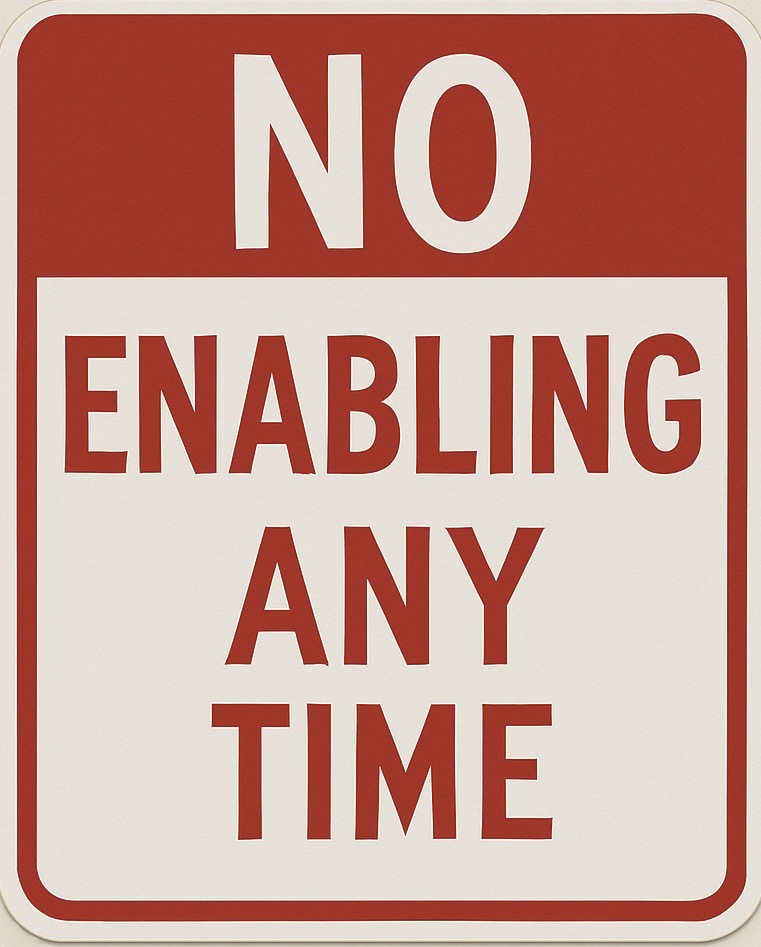

"It's Just This Once": The Common Rationalizations That Keep Enabling Going
Discover the most common rationalizations families use to justify enabling a loved one's addiction—and how to break the cycle with honest, compassionate action.
Direct answer
How do I know if I am helping or enabling?
Helping supports responsibility, truth, treatment, and repair. Enabling protects addiction from consequences, usually through money, excuses, housing, secrecy, or emotional rescue.
Reviewed through Matt Brown's family intervention and coaching lens.
Open full answer →Why this is here
Families rarely need more pressure. They need clearer patterns, steadier boundaries, and a next step they can actually hold.
Written from intervention experience
This article is part of No More Enabling’s family education library, shaped by Matt Brown’s work with families affected by addiction, treatment resistance, relapse, and boundary breakdowns since 2004.
Author and editorial reviewer: Matt Brown, professional interventionist and family addiction coach. Medical claims require separate qualified clinical review.
Read this as part of a bigger pattern
If this article hits home, these guided hubs will help you keep reading in a smarter order instead of starting from scratch each time.
Adult Child Addiction Hub
Best when you are asking how to stay loving without becoming the safety net for active addiction.
Open hub →
Financial Enabling Hub
Best when you need to help without becoming the financial safety net that keeps the addiction cycle alive.
Open hub →
Treatment Resistance Hub
Best when conversations about treatment keep failing and the family needs a calmer, more structured next move.
Open hub →
If this article sounds like your family
Do this next
If the real issue is holding the line, don’t stop at reading. Work through the boundaries course next.
Next best step
Choose your next step
If this article sounds like your family, use the short assessment to route the situation before the next hard conversation.
When your family needs a real plan
Coaching and intervention guidance with Matt Brown
If articles are helping but the situation at home is still escalating, you can ask for direct help with family alignment, boundaries, treatment refusal, relapse patterns, or deciding whether an intervention makes sense.
High-intent next step
Family addiction coaching with Matt Brown for enabling and boundaries
Get private family addiction coaching from Matt Brown for enabling, boundaries, treatment refusal, relapse, money decisions, and a clear next step.
You already know something is wrong. On some level, you've known for a while. But every time you get close to making a change — stopping the money, refusing to call in sick for them, letting them face a consequence — a voice in your head steps in with a very reasonable-sounding explanation for why now isn't the right time.
That voice isn't weakness. It's love trying to protect itself. But when that voice keeps you stuck in patterns that make things worse, it stops being love and starts being a problem.
Today we're going to name those voices directly. Not to shame you — you've had enough of that — but because naming them is often the first real step toward something different.
Why Do Families Rationalize Enabling Behaviors?
Rationalizations are the stories we tell ourselves to make uncomfortable decisions feel okay. Every family member of someone struggling with addiction has a library of them. They aren't signs of stupidity — they're signs of how much pain everyone is in.
The tricky part: most rationalizations contain a kernel of truth. That's what makes them so effective. They're not pure fantasy. They're true enough to be convincing, and just distorted enough to keep you from acting.
Here are the most common ones — and what's actually happening underneath each of them.
"They'll Hit Rock Bottom Soon Anyway — I'm Just Keeping Them Safe Until Then"
This is probably the most common rationalization in the family playbook. The idea of "rock bottom" is real — people do often need to feel the full weight of their consequences before they're willing to change. The problem is that families frequently define "keeping them safe" as removing the very consequences that create that weight.
Paying rent so they don't end up on the street. Covering a car payment so they don't lose their job. Bailing them out so they don't sit in a jail cell. These feel like harm reduction. And sometimes, in very specific circumstances, they might be. But more often, they simply delay the moment of reckoning — and at significant cost to you.
The honest question to ask: Am I actually keeping them safe, or am I keeping myself from having to watch them suffer?
"If I Don't Help, Something Terrible Will Happen"
This one runs deep, especially for parents. The fear underneath it is real: addiction can be fatal, and families know it. So when a loved one says — explicitly or implicitly — "I need this or I don't know what I'll do," the family member hears a threat and responds to it.
Here's what's worth understanding: people in active addiction are often skilled, sometimes unconsciously, at leveraging that fear. Not because they're bad people — but because their brain has reorganized itself around getting the next fix, and your fear is a resource. It works.
The harder truth is that no amount of money, cover stories, or emergency rescues has ever prevented addiction from progressing. What changes the outcome is treatment, accountability, and a real confrontation with consequences — not another intervention in the crisis of the week.
Ask yourself: Has doing this before actually made things better — or just quieter for a few days?
"I Don't Want to Push Them Away"
This rationalization is rooted in love, and it's worth honoring that. The fear of rupturing the relationship — of becoming the enemy, of your loved one walking out of your life — is legitimate and painful.
But here's what the research and the clinical experience consistently show: the relationship is already being destroyed by the addiction. What families often protect by staying quiet and compliant is not the real relationship — it's a surface version of it, held together by avoidance and accommodation.
Setting a limit with someone you love is not abandonment. Done with love and consistency, it's one of the clearest messages you can send: I love you too much to keep participating in your destruction.
Will it feel that way to them at first? Probably not. But love doesn't always feel like love in the moment.
"This Time Is Different"
They got a new job. They met someone new. They said they were done with the old crowd. They seemed really sincere. Hope is not a character flaw — and it shouldn't be treated as one.
But there's a difference between hope grounded in observable, sustained behavior change and hope grounded in a very convincing conversation you had two days ago.
The families who fare best in these situations learn to apply what might be called a 90-day rule: watch what someone does over 90 days, not what they say in a single moment. Promises are data, but they're weak data. Consistent, repeated behavior over time — that's where the truth lives.
Optimism is healthy. Optimism that bypasses evidence isn't optimism — it's hope as a coping strategy.
How to Catch Yourself in a Rationalization
You don't have to be perfect at this. You just have to be willing to pause long enough to ask a few honest questions before you act.
Try these:
- Is this decision based on evidence, or on what I'm hoping is true?
- Am I acting to reduce their discomfort, or my own?
- If I do this, what am I actually teaching them about consequences?
- Have I done this before? Did it help?
- What would I tell a close friend to do if they were in my position?
You don't need to answer these perfectly. But sitting with them honestly — even for five minutes before you respond — can create enough space to choose differently.
You're Not a Bad Person. You're a Person in a Hard Situation.
Recognizing your own rationalizations doesn't mean you've been doing everything wrong. It means you've been doing the best you could with what you understood at the time. That's worth acknowledging.
What changes is what you do next. Not all at once — making changes in these situations is its own process — but one decision at a time, with a little more honesty than the decision before it.
You came to this page for a reason. That reason matters. Give yourself credit for being willing to look, and then take one honest step forward.
Frequently Asked Questions
Is it really enabling if I'm just trying to keep my loved one safe?
It depends on the pattern. A single act of help isn't automatically enabling. Enabling is a repeated pattern in which your assistance reliably protects your loved one from the natural consequences of their addiction — making it easier for the addiction to continue. If your help has become a consistent buffer between them and accountability, it's worth examining honestly.
How do I know if my reasoning is a rationalization or a genuine exception?
Ask yourself whether you've used this exact reasoning before — and whether the outcome was different. Genuine exceptions are rare and specific. Rationalizations tend to be reusable: they show up every time a limit gets close. If the same logic appears every crisis, it's a pattern, not an exception.
Can stopping enabling actually push someone deeper into addiction?
This fear is real but not well-supported by evidence. What we know is that consistent consequences — not emotional cutoff, but real-world accountability — are among the strongest motivators for people to seek help. Stopping enabling doesn't create the addiction. It removes the infrastructure that makes it more sustainable.
What if my loved one says I'm being cruel when I stop helping?
That reaction is very common, and it's painful to experience. It doesn't mean you're doing something wrong — it often means you're doing something right. When a loved one escalates anger or guilt in response to a limit, that's frequently a sign the limit is landing. You can hold your position and still feel sad about it. Both things can be true.
Where can I get help understanding my enabling patterns?
SoberHelpline.com offers one-on-one family coaching and a membership community specifically designed to help families identify and change enabling patterns. If your loved one's situation has escalated to a crisis point, FreedomInterventions.com provides professional intervention services.
Ready to Get Support?
If you're recognizing yourself in any of these rationalizations, you're not alone — and you don't have to figure this out by yourself.
Visit SoberHelpline.com to connect with a family coach, join a community of families who understand what you're going through, or attend a free Monday night Family Squares call. If your loved one's addiction has reached a crisis point and you're considering intervention, reach out at FreedomInterventions.com.
One honest step is enough to start.
Free family tool
Financial Boundaries Script
A short script for saying no to cash, rent, bills, and last-minute rescue requests without getting pulled into another negotiation.
This does not replace the Family Squares meeting. It gives you a practical tool first, then points you toward the live support room if you need help using it.
Get weekly guidance for families dealing with enabling
Every Sunday, one short email with practical family guidance on boundaries, enabling, relapse, and next steps.
"Practical, not preachy. It reads like someone who has actually sat with families instead of a wellness blog."
— Sister of a brother in relapse
Trust signals
Source-worthy public resources
These links are not a substitute for medical, legal, or crisis care. They are included to help families verify safety and treatment information from official sources.
Next best answers
If this is what you were really asking
How do I know if I am helping or enabling?
Helping supports responsibility, truth, treatment, and repair. Enabling protects addiction from consequences, usually through money, excuses, housing, secrecy, or emotional rescue.
Open answer →
How do I stop enabling without abandoning someone I love?
Stop doing what protects the addiction, but stay available for recovery-supporting action. The goal is not less love. The goal is cleaner support.
Open answer →
What if the other house is running a different plan?
Two houses. One disease. If one parent pays rent and the other hands over the keys, nothing holds. Money, housing, and contact have to be the same line in both kitchens. You cannot control the other house. You can stop being the second rescue.
Open answer →
What should I do when an addicted loved one breaks a boundary?
Do not renegotiate the boundary in the heat of the moment. Follow through calmly, document the pattern, and review whether the boundary was specific enough to hold.
Open answer →
Need a steadier next step?
Don’t stop at insight
The families who make progress usually do three things: they get honest about the pattern, choose one clearer next step, and stop trying to manage everything at once.
Helping or Enabling? Tool
Best when you keep second-guessing what support should look like.
Family Support Guide
Best when everything feels heavy, urgent, or emotionally scrambled.
Free Boundaries Course
Best when your limits keep getting negotiated away under pressure.
About Matt Brown and this site
Understand the experience and point of view behind the guidance here.

FamilyBridge
AI support for families across the recovery journey.