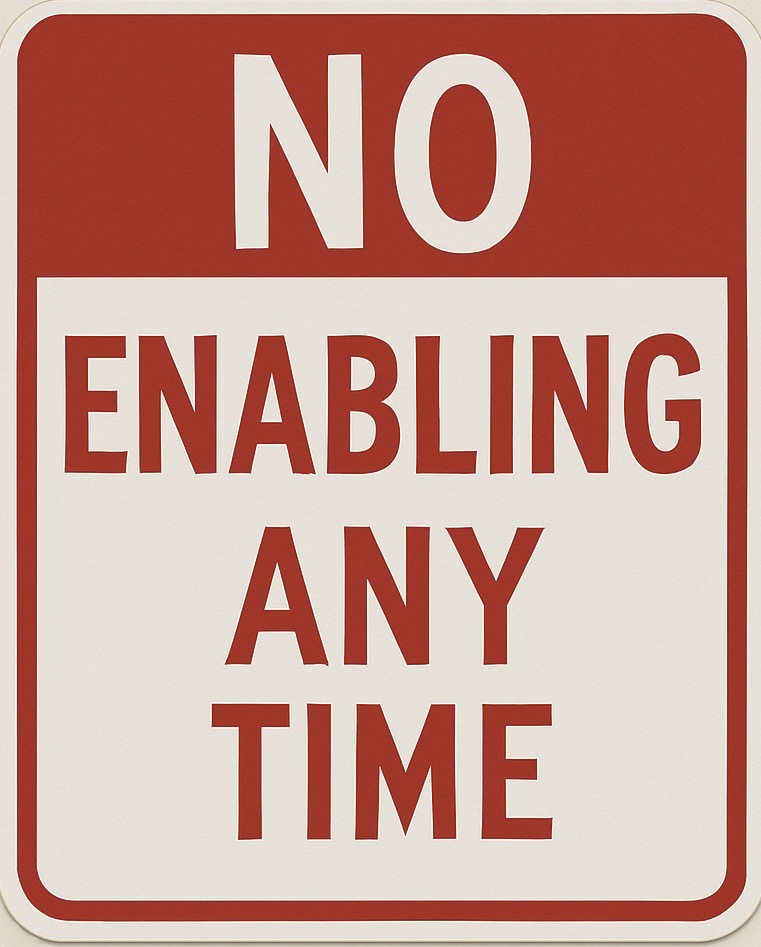

When Holding the Line Feels Like the Wrong Thing: Staying Committed to Your Limits Despite Guilt
Holding limits with an addicted loved one feels cruel — but guilt doesn't mean you're wrong. Learn how to stay committed to your limits when it hurts.
Direct answer
How do I know if I am helping or enabling?
Helping supports responsibility, truth, treatment, and repair. Enabling protects addiction from consequences, usually through money, excuses, housing, secrecy, or emotional rescue.
Reviewed through Matt Brown's family intervention and coaching lens.
Open full answer →Why this is here
Families rarely need more pressure. They need clearer patterns, steadier boundaries, and a next step they can actually hold.
Written from intervention experience
This article is part of No More Enabling’s family education library, shaped by Matt Brown’s work with families affected by addiction, treatment resistance, relapse, and boundary breakdowns since 2004.
Author and editorial reviewer: Matt Brown, professional interventionist and family addiction coach. Medical claims require separate qualified clinical review.
Read this as part of a bigger pattern
If this article hits home, these guided hubs will help you keep reading in a smarter order instead of starting from scratch each time.
Enabling Hub
Best when you keep wondering whether your support is helping or making the pattern worse.
Open hub →
Boundaries Hub
Best when your loved one keeps crossing lines and you are tired of repeating yourself.
Open hub →
Codependency Hub
Best when exhaustion, guilt, hypervigilance, and over-functioning have become normal.
Open hub →
If this article sounds like your family
Do this next
If the real issue is holding the line, don’t stop at reading. Work through the boundaries course next.
Next best step
Choose your next step
If this article sounds like your family, use the short assessment to route the situation before the next hard conversation.
When your family needs a real plan
Coaching and intervention guidance with Matt Brown
If articles are helping but the situation at home is still escalating, you can ask for direct help with family alignment, boundaries, treatment refusal, relapse patterns, or deciding whether an intervention makes sense.
High-intent next step
Family addiction coaching with Matt Brown for enabling and boundaries
Get private family addiction coaching from Matt Brown for enabling, boundaries, treatment refusal, relapse, money decisions, and a clear next step.

You finally said it. You set a limit, held to it, and your loved one reacted exactly the way you feared — anger, tears, or silence that could fill a room. Now the guilt has arrived, right on schedule, whispering that a good parent, a loving spouse, a decent sibling would never do this.
Here's what's true: holding boundaries with an addicted loved one is one of the hardest things you will ever do. It is also one of the most loving. The guilt you're feeling right now doesn't mean you did something wrong. It means you're paying attention. The question is whether you let that guilt reverse a decision that was right.
This article is for the moment after you set the limit — when doubt moves in and you're not sure you can hold it. You can. Here's how.
Why Guilt Hits Hardest Right After You Hold a Limit
Guilt after holding a boundary with an addicted loved one is almost universal. It doesn't mean you crossed a line — it usually means your loved one did, and you didn't rescue them this time.
When someone who struggles with addiction pushes back against a new limit, the emotional reaction can be intense: accusations, pleading, reminders of past sacrifices, or cold withdrawal. Your nervous system reads that as danger — someone you love is in pain and it looks like your fault.
But consider what's actually happening. Your loved one has learned, over months or years, that emotional escalation works. When they push hard enough, the limit softens, the money arrives, the consequence disappears. Their reaction isn't proof that you're cruel. It's proof that you're changing a system they've counted on.
Understanding this doesn't make the guilt vanish. But it does give you a frame for what the guilt actually is: discomfort during transition, not evidence of wrongdoing.
What Does 'Staying Committed to Your Limits' Actually Look Like?
Staying consistent with a boundary doesn't mean becoming cold, cutting off communication, or never revisiting decisions. It means not undoing the limit because you feel uncomfortable.
In practice, this looks like:
- Saying the same thing twice without escalating. If you've told your adult child you won't pay their rent while they're using, you don't need a new speech every time they ask. One calm restatement is enough.
- Not explaining yourself into a corner. Over-explaining your reasoning gives the other person material to argue with. "I love you and this is my limit" is a complete sentence.
- Returning to your limit after a wobble. You don't have to be perfect. If guilt pulled you off track once, the next moment is still a chance to re-anchor.
- Being consistent across good days and bad days. Limits that only hold when things are tense teach your loved one that persistence pays off.
Consistency is not rigidity. You can be warm, patient, and empathetic while still not moving the goalposts.
What to Say When Your Loved One Makes the Guilt Worse
Most pushback on limits isn't rational argument — it's emotional pressure. Knowing that in advance helps you prepare. Here are some common situations and language that holds without escalating.
When they say: "You don't care about me."
Try: "I care about you. That's why I'm not going to keep doing something that isn't helping you."
Don't argue about whether you care. You know you do. State it once and don't defend it repeatedly — that road goes nowhere.
When they say: "This is the worst possible time."
Try: "I hear you. My limit stays the same."
There will always be a reason the timing is wrong. Addiction creates perpetual crisis. If you wait for a good time to hold a limit, you will wait forever.
When they go silent or disappear
Silence can feel like punishment — and sometimes it is. Let them have their space without chasing. Chasing communicates that their withdrawal works. It doesn't require a response from you.
When they bring up your past mistakes
Try: "That's a fair thing to raise another time. Right now, I'm staying with what I said."
Bringing up old wounds is a classic way to derail a hard conversation. You can acknowledge the past without letting it hijack the present.
How to Handle the Guilt Privately So It Doesn't Leak Into the Limit
Guilt doesn't disappear because you understand it intellectually. You still have to deal with it — just not by collapsing the limit.
Some practical ways to process guilt without reversing your commitment:
- Write it down. Put the guilt on paper — what you're afraid of, what you imagine happening, what it would mean if you were wrong. Getting it out of your head creates a little distance.
- Talk to someone who gets it. A sponsor, a therapist, a trusted friend, an Al-Anon group. Not someone who will simply validate your guilt, but someone who will help you see it clearly.
- Ask yourself one question: Am I pulling back this limit because something genuinely changed, or because I'm uncomfortable? If the honest answer is the latter, that's your information.
- Remember what staying on course is for. You're not holding this limit to punish your loved one. You're holding it because enabling isn't helping them. The discomfort is the point — it's what creates the conditions where something might shift.
Guilt handled privately stays your problem. Guilt handled at the boundary becomes everyone's problem.
When It's Right to Revisit a Limit — and When It Isn't
Not every limit is permanent, and not every revision is a failure. Here's how to tell the difference between thoughtful recalibration and guilt-driven capitulation.
It may be right to revisit a limit when:
- Something genuinely significant changed (your loved one entered treatment, a real crisis emerged, new information came in).
- You set the limit out of anger or fear and it wasn't something you actually wanted to hold long-term.
- You've had a calm, grounded conversation with a trusted advisor who helped you see something you missed.
It is probably not time to revisit the limit when:
- Your loved one is upset, and the main thing driving your reconsideration is their emotional reaction.
- You're in the middle of a conflict and walking it back feels like the fastest way to end the tension.
- You haven't talked to anyone else — you're just sitting alone with the guilt spiral.
The distinction is where the pressure is coming from. External pressure (their reaction) is rarely a good reason to move. Internal clarity (genuine new information, sober reflection) is a real reason to revisit.
You Are Allowed to Stay Decided
There is a quiet kind of courage in holding a limit when your loved one is hurting and you're not sure you're doing the right thing. It doesn't look like strength from the outside. It usually looks like sitting still while everything in you wants to fix it.
But here is what experience with families shows, again and again: the limit you hold today — even imperfectly, even through guilt — is often what creates the opening for something to change. Not because it punishes your loved one into recovery. Because it stops the system from working the way it always has.
You are allowed to stay decided. You are allowed to love someone deeply and still not rescue them from consequences they created. You are allowed to feel terrible about it and keep going anyway.
If you'd like support from a professional who works with families in exactly this place, the team at SoberHelpline.com offers coaching built around these moments. And if you're starting to wonder whether a more structured intervention is the right next step, FreedomInterventions.com is a place to start that conversation.
Frequently Asked Questions
Is it normal to feel guilty after holding a boundary with an addicted loved one?
Yes — it's nearly universal. Guilt after holding a limit usually means your loved one reacted strongly, not that you did something wrong. The discomfort is a sign the system is changing, which is exactly what needs to happen.
What do I do when my addicted loved one cries or gets angry when I hold a limit?
Stay calm and don't add more words. Restate your limit once if needed, acknowledge their feelings briefly, and resist the urge to argue or over-explain. Their emotional reaction is real, but it isn't evidence that you're wrong.
How do I know if I should change a limit I've already set?
Ask yourself whether something genuinely changed or whether you're responding to emotional pressure. Talk to a trusted advisor first. If the main driver is your loved one's distress rather than new information or your own grounded reflection, it's probably not time to move.
Can I hold limits with my loved one and still have a relationship with them?
Yes. Limits and love are not opposites. Many families find that consistent, clear limits — held with warmth rather than punishment — actually stabilize the relationship over time by removing the constant negotiation and resentment that comes from enabling.
What if I already caved once — does that mean I've failed?
No. One slip doesn't erase your work. The next moment you hold the limit still counts. Consistency over time matters more than perfection in a single interaction. Start from wherever you are now.
When should I consider a professional intervention instead of just holding limits on my own?
If your loved one's use is escalating, if safety is a concern, or if holding limits alone isn't producing any change over time, a professional interventionist can help. Visit FreedomInterventions.com to learn more about that process.
Get weekly guidance for families dealing with boundaries
Every Sunday, one short email with practical family guidance on boundaries, enabling, relapse, and next steps.
"Practical, not preachy. It reads like someone who has actually sat with families instead of a wellness blog."
— Sister of a brother in relapse
Trust signals
Source-worthy public resources
These links are not a substitute for medical, legal, or crisis care. They are included to help families verify safety and treatment information from official sources.
Next best answers
If this is what you were really asking
How do I know if I am helping or enabling?
Helping supports responsibility, truth, treatment, and repair. Enabling protects addiction from consequences, usually through money, excuses, housing, secrecy, or emotional rescue.
Open answer →
What is the first boundary a family should set?
Start with the behavior that is costing the most safety, honesty, money, or stability. A boundary should define what you will do if the behavior continues.
Open answer →
What is codependency in addiction families?
Codependency is the pattern where a family member becomes over-responsible for another person's addiction, emotions, consequences, or recovery.
Open answer →
What if my family disagrees about addiction boundaries?
Family disagreement often keeps addiction protected. Start by aligning around safety, money, children, and what nobody will cover up anymore, even if everyone is not ready for the same boundary.
Open answer →
Need a steadier next step?
Don’t stop at insight
The families who make progress usually do three things: they get honest about the pattern, choose one clearer next step, and stop trying to manage everything at once.
Helping or Enabling? Tool
Best when you keep second-guessing what support should look like.
Family Support Guide
Best when everything feels heavy, urgent, or emotionally scrambled.
Free Boundaries Course
Best when your limits keep getting negotiated away under pressure.
About Matt Brown and this site
Understand the experience and point of view behind the guidance here.

FamilyBridge
AI support for families across the recovery journey.