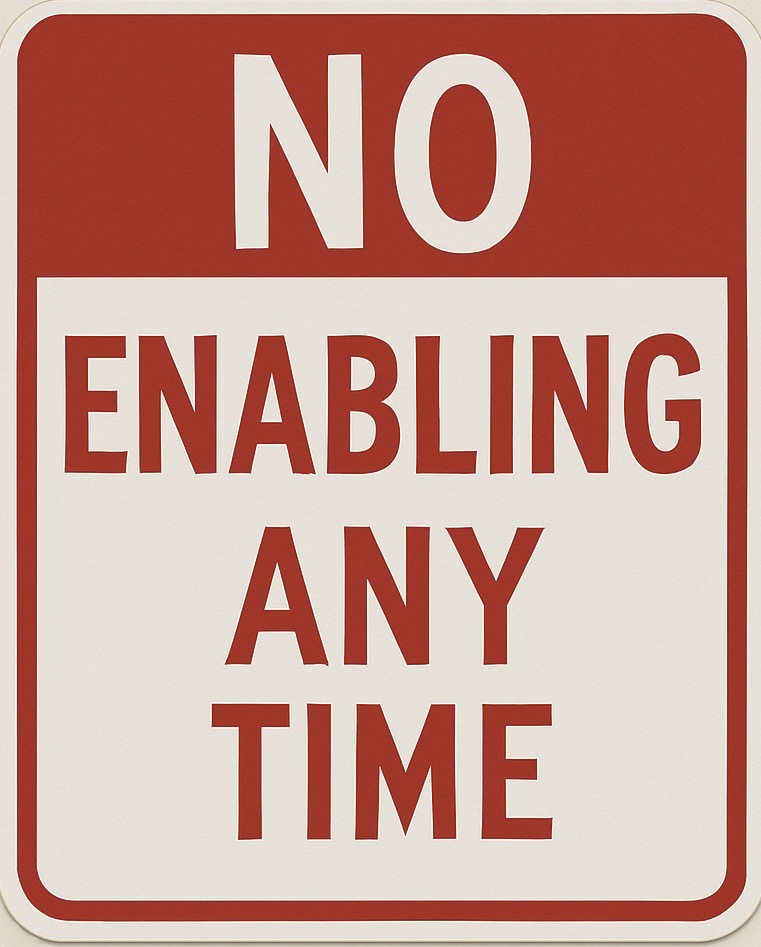

Will Setting Boundaries With an Addicted Loved One Push Them Away?
Afraid that setting boundaries with an addicted loved one will push them away? Learn why healthy boundaries protect the relationship instead of ending it.
Direct answer
How do I know if I am helping or enabling?
Helping supports responsibility, truth, treatment, and repair. Enabling protects addiction from consequences, usually through money, excuses, housing, secrecy, or emotional rescue.
Reviewed through Matt Brown's family intervention and coaching lens.
Open full answer →Why this is here
Families rarely need more pressure. They need clearer patterns, steadier boundaries, and a next step they can actually hold.
Written from intervention experience
This article is part of No More Enabling’s family education library, shaped by Matt Brown’s work with families affected by addiction, treatment resistance, relapse, and boundary breakdowns since 2004.
Author and editorial reviewer: Matt Brown, professional interventionist and family addiction coach. Medical claims require separate qualified clinical review.
Read this as part of a bigger pattern
If this article hits home, these guided hubs will help you keep reading in a smarter order instead of starting from scratch each time.
Adult Child Addiction Hub
Best when you are asking how to stay loving without becoming the safety net for active addiction.
Open hub →
Financial Enabling Hub
Best when you need to help without becoming the financial safety net that keeps the addiction cycle alive.
Open hub →
Treatment Resistance Hub
Best when conversations about treatment keep failing and the family needs a calmer, more structured next move.
Open hub →
If this article sounds like your family
Do this next
If the real issue is holding the line, don’t stop at reading. Work through the boundaries course next.
Next best step
Choose your next step
If this article sounds like your family, use the short assessment to route the situation before the next hard conversation.
When your family needs a real plan
Coaching and intervention guidance with Matt Brown
If articles are helping but the situation at home is still escalating, you can ask for direct help with family alignment, boundaries, treatment refusal, relapse patterns, or deciding whether an intervention makes sense.
High-intent next step
Family addiction coaching with Matt Brown for enabling and boundaries
Get private family addiction coaching from Matt Brown for enabling, boundaries, treatment refusal, relapse, money decisions, and a clear next step.
If you love someone who struggles with addiction, there is probably one fear that has stopped you from setting boundaries with an addicted loved one more than any other: the fear that they will leave. That they will stop calling. That they will use more, disappear, or get hurt — and that it will be your fault.
That fear makes sense. You are not weak for feeling it. You have watched this person pull away before, and you have learned that keeping them close sometimes feels like the only way to keep them alive. So you say yes when you mean no. You soften every limit the moment it gets tested.
Healthy boundaries can strain or change a relationship, especially when old rescue patterns are challenged. They do not guarantee closeness or recovery. Their purpose is to protect what you can control: your safety, your participation, and the conditions under which connection remains possible.
Why Does Setting a Boundary Feel Like Abandonment?
Setting a boundary feels like abandonment because, for years, closeness and caretaking have been fused together in your relationship. If love has always looked like rescuing — paying the bill, smoothing the crisis, absorbing the consequence — then stepping back from rescuing can feel like stepping back from love itself. It isn't. But your nervous system doesn't know that yet.
There's also a practical reason it feels this way: your loved one may tell you it's abandonment. "If you really loved me, you'd help me." "Fine, I guess I just won't have a family anymore." Addiction is skilled at translating any limit into rejection, because limits threaten its supply of protection and resources.
It helps to name the difference plainly:
- Abandonment says: "I'm done with you. You're on your own."
- A boundary says: "I love you, and I'm no longer willing to participate in what's hurting you. I'm right here when you want something different."
Those are not the same sentence. They are not even in the same family. One closes a door. The other holds it open — while refusing to keep furnishing the room addiction lives in. If you are still sorting out where that line sits, our guide to the difference between a boundary and a punishment is worth reading next.
What Actually Pushes an Addicted Loved One Away?
The short answer: addiction pushes people away — and, surprisingly, so does enabling. When we protect someone from every consequence, we don't bring them closer. We help the addiction stay comfortable, and a comfortable addiction has no reason to change. Over time, the relationship hollows out anyway: the calls become transactions, the visits become negotiations, and resentment builds on both sides.
Many family members discover that the closeness they were protecting was already gone. What they had was contact — frequent, anxious, crisis-driven contact — not connection. Boundaries can cost you some of that contact in the short term. What they protect is the possibility of real connection later.
There is one honest caveat. When you first set a boundary, your loved one may pull back, get angry, or go quiet for a while. That distance is usually temporary, and it is not proof the boundary was wrong. It's often proof that the boundary touched something real. Anger at a limit is not the same as the end of a relationship — see what to expect when an addict tests your boundaries.
How Do Boundaries Protect the Relationship?
Boundaries protect the relationship by removing the two things that quietly destroy it: your resentment and their dependence on your rescuing. When you stop doing things you deeply resent, you stop needing your loved one to be grateful, and you stop keeping score. When they stop being able to hand you every consequence, the relationship slowly stops being a hostage negotiation.
Think about what your loved one actually gets when you hold a limit calmly:
- A parent, spouse, or sibling who is steadier and less frightened — someone worth coming home to when recovery starts
- An honest mirror: one person in their life whose words and actions match
- Proof that love does not require participation in the addiction — which is exactly the kind of love that supports recovery later
Families often expect a boundary to be the moment everything ruptures. More often, it is the moment the relationship stops eroding. You can't build trust with someone while you are secretly furious at them, and they can't respect someone they've learned to manage.
What If They Really Do Walk Away?
Sometimes a loved one does go quiet after a boundary — for days, weeks, occasionally longer. If that happens, remember what the silence usually means: the addiction is looking for easier terms somewhere else. That is painful, and it is not the same as losing them forever.
You cannot control whether they walk away. You can control what they walk away from and what they can come back to. Here is what holding steady looks like:
- Keep the door visibly open. Boundaries limit behavior, not love. It's okay to send a message that says, "I love you. My answer about money hasn't changed. I'd love to have dinner with you Sunday."
- Don't chase, and don't punish. You don't need to reverse the boundary to prove your love, and you don't need to add coldness to prove your resolve.
- Let the boundary do its work. Consequences — experienced, not threatened — are often what finally makes treatment look better than continuing to use.
And if the fear underneath all of this is safety — overdose, homelessness, self-harm — say that out loud to someone who can help you plan for it. A boundary strategy for a high-risk situation should be built with support, not alone at your kitchen table at 2 a.m.
How to Set the Boundary Without Slamming the Door
The way you deliver a boundary matters almost as much as the boundary itself. A limit delivered in rage sounds like rejection. The same limit delivered calmly sounds like clarity. A simple structure:
- Lead with love: "I love you, and that's not changing."
- State the limit plainly, without a lecture: "I'm not able to give you money anymore."
- Offer what you are willing to do: "I will always help you get to treatment, and you're welcome at family dinner sober."
Then stop talking. No justifying, no debating, no re-litigating the past. One sentence of love, one sentence of limit, one sentence of what remains open. The shorter it is, the more loving it sounds — because it leaves no argument to have, only a choice to make.
You're Not Choosing Between Boundaries and Your Loved One
That's the false choice fear keeps offering you: boundaries or the relationship. In reality, the relationship you're afraid of losing is already being taken — slowly — by the addiction. Setting boundaries with an addicted loved one is not how you lose them. It's how you stop losing yourself, and how you become the kind of steady, honest presence that recovery can actually attach to. You can love someone completely and still say no. In fact, sometimes no is the most loving word you have left.
Where to Go From Here
You don't have to figure out boundaries alone, and you don't have to get them perfect on the first try. If you want guidance from people who work with families like yours every day, visit SoberHelpline.com for family coaching for addiction, education, and a supportive membership community. And if your loved one's addiction has reached the point where the family needs structured help to move them toward treatment, FreedomInterventions.com can walk you through what a professional intervention looks like. Either way, take one step this week. Your relationship is worth protecting — and so are you.
Frequently Asked Questions
Will my addicted loved one hate me if I set boundaries?
They may be angry at first, because boundaries interrupt what the addiction relies on. Anger at a limit is usually temporary and is not the same as hate. Many people in recovery later say the family member who held firm boundaries is the one they trust most.
What if my loved one cuts off contact after I set a boundary?
Some distance after a new boundary is common and usually short-lived. Keep the door open with occasional, pressure-free messages of love, and don't reverse the boundary to end the silence. If safety is a genuine concern, involve a professional to help you plan.
Is setting boundaries the same as giving up on someone?
No. Giving up means withdrawing love and hope. A boundary withdraws only your participation in the addiction — money, cover-ups, rescue missions — while keeping love, contact, and support for recovery fully available.
Can boundaries actually help my loved one get sober?
Boundaries alone don't cause sobriety, but they remove the cushioning that makes active addiction comfortable. When consequences land where they belong, treatment starts to look like the better option. Families who hold healthy limits often play a major role in a loved one's decision to get help.
How do I deal with the guilt after setting a boundary?
Expect guilt — it's a sign you're changing an old pattern, not a sign you're wrong. Remind yourself what the boundary protects, talk to people who understand (a family coach, Al-Anon, a therapist), and give it time. Guilt fades; the benefits of the boundary compound.
Free family tool
Financial Boundaries Script
A short script for saying no to cash, rent, bills, and last-minute rescue requests without getting pulled into another negotiation.
This does not replace the Family Squares meeting. It gives you a practical tool first, then points you toward the live support room if you need help using it.
Get weekly guidance for families dealing with boundaries
Every Sunday, one short email with practical family guidance on boundaries, enabling, relapse, and next steps.
"Practical, not preachy. It reads like someone who has actually sat with families instead of a wellness blog."
— Sister of a brother in relapse
Trust signals
Source-worthy public resources
These links are not a substitute for medical, legal, or crisis care. They are included to help families verify safety and treatment information from official sources.
Next best answers
If this is what you were really asking
How do I stop enabling without abandoning someone I love?
Stop doing what protects the addiction, but stay available for recovery-supporting action. The goal is not less love. The goal is cleaner support.
Open answer →
What if the other house is running a different plan?
Two houses. One disease. If one parent pays rent and the other hands over the keys, nothing holds. Money, housing, and contact have to be the same line in both kitchens. You cannot control the other house. You can stop being the second rescue.
Open answer →
How do I know if I am helping or enabling?
Helping supports responsibility, truth, treatment, and repair. Enabling protects addiction from consequences, usually through money, excuses, housing, secrecy, or emotional rescue.
Open answer →
What should I do when an addicted loved one breaks a boundary?
Do not renegotiate the boundary in the heat of the moment. Follow through calmly, document the pattern, and review whether the boundary was specific enough to hold.
Open answer →
Need a steadier next step?
Don’t stop at insight
The families who make progress usually do three things: they get honest about the pattern, choose one clearer next step, and stop trying to manage everything at once.
Helping or Enabling? Tool
Best when you keep second-guessing what support should look like.
Family Support Guide
Best when everything feels heavy, urgent, or emotionally scrambled.
Free Boundaries Course
Best when your limits keep getting negotiated away under pressure.
About Matt Brown and this site
Understand the experience and point of view behind the guidance here.

FamilyBridge
AI support for families across the recovery journey.