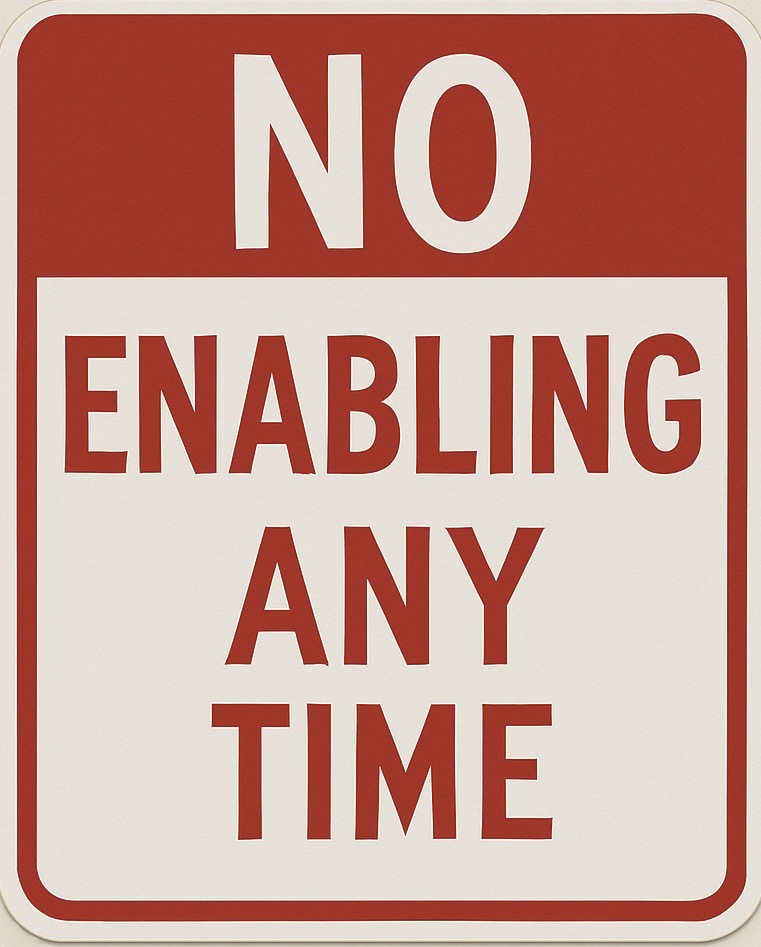

When Love Becomes Enabling: Supporting Families of Those Struggling with Addiction
Enabling is not a character flaw. It is what love does when it doesn't know what else to do. This guide explores how families can recognize enabling patterns, set strategic boundaries, and find support — without shame.
Direct answer
How do I know if I am helping or enabling?
Helping supports responsibility, truth, treatment, and repair. Enabling protects addiction from consequences, usually through money, excuses, housing, secrecy, or emotional rescue.
Reviewed through Matt Brown's family intervention and coaching lens.
Open full answer →Why this is here
Families rarely need more pressure. They need clearer patterns, steadier boundaries, and a next step they can actually hold.
Written from intervention experience
This article is part of No More Enabling’s family education library, shaped by Matt Brown’s work with families affected by addiction, treatment resistance, relapse, and boundary breakdowns since 2004.
Author and editorial reviewer: Matt Brown, professional interventionist and family addiction coach. Medical claims require separate qualified clinical review.
Read this as part of a bigger pattern
If this article hits home, these guided hubs will help you keep reading in a smarter order instead of starting from scratch each time.
Enabling Hub
Best when you keep wondering whether your support is helping or making the pattern worse.
Open hub →
Boundaries Hub
Best when your loved one keeps crossing lines and you are tired of repeating yourself.
Open hub →
Codependency Hub
Best when exhaustion, guilt, hypervigilance, and over-functioning have become normal.
Open hub →
If this article sounds like your family
Do this next
If the real issue is holding the line, don’t stop at reading. Work through the boundaries course next.
Next best step
Choose your next step
If this article sounds like your family, use the short assessment to route the situation before the next hard conversation.
When your family needs a real plan
Coaching and intervention guidance with Matt Brown
If articles are helping but the situation at home is still escalating, you can ask for direct help with family alignment, boundaries, treatment refusal, relapse patterns, or deciding whether an intervention makes sense.
High-intent next step
Family addiction coaching with Matt Brown for enabling and boundaries
Get private family addiction coaching from Matt Brown for enabling, boundaries, treatment refusal, relapse, money decisions, and a clear next step.
There is a particular kind of exhaustion that only families of people with addiction know. It lives somewhere between hope and dread — in the space of waiting for a phone call, scanning a face for signs, or quietly slipping money across a table because the alternative feels unbearable. It is a love that has slowly, almost invisibly, twisted into something that no longer helps the person it's meant for.
Enabling is not a character flaw. It is what love does when it doesn't know what else to do.
## Understanding Enabling — Without Shame
The word "enabling" carries weight. For many family members, hearing it feels like an accusation: *You are part of the problem.* But that framing misses something crucial. Enabling behaviors almost always originate from the most human of impulses — the desire to protect someone you love from pain.
Enabling looks like calling in sick for a son who is hungover. It looks like covering a daughter's rent so she doesn't lose her apartment, even as her addiction deepens. It looks like staying silent about a spouse's drinking because bringing it up always leads to a fight. It looks like bailing someone out of jail, again, because you cannot bear the thought of them in a cell.
None of these acts feel like enabling in the moment. They feel like love. They feel like survival. And in many cases, they temporarily are survival — preventing immediate harm while the family figures out what to do next.
The problem is that over time, these protective actions can remove the natural consequences that might otherwise motivate someone to seek help. They can also take a devastating toll on the people doing the enabling — financially, emotionally, and physically.
## The Family System in Addiction
Addiction is rarely just one person's struggle. Research and clinical experience consistently show that addiction functions within a family system, affecting and shaping every member. Roles develop — the caretaker, the peacemaker, the scapegoat, the invisible child — as family members unconsciously organize themselves around the addiction to keep the family functioning.
Therapists working with families often observe that by the time a loved one seeks treatment, the rest of the family is in crisis too. Spouses show symptoms of anxiety and depression. Children carry shame and hypervigilance into adulthood. Parents are financially depleted and emotionally hollowed out.
This means that supporting families isn't a secondary concern in addiction treatment — it is central to it. Healing the family system, or at minimum supporting individual family members, improves outcomes not only for the family but for the person with the addiction as well.
## What Families Need — and Rarely Get
Despite this, families are often an afterthought in the treatment landscape. Most addiction services are built around the individual. Family members are brought in for an education session, perhaps a family therapy weekend, and then largely left to manage on their own.
What families actually need is more layered than a single intervention.
Validation and psychoeducation. Many family members carry enormous shame and confusion. They need to understand that addiction is a complex, chronic condition — not a moral failure, not something they caused, and not something they can control. They need to hear that the behaviors they've engaged in made sense given what they knew and felt at the time. This is not absolution that lets them off the hook; it is the ground they need to stand on before they can change anything.
Their own support, separate from their loved one's treatment. Groups like Al-Anon, Nar-Anon, and SMART Recovery Family & Friends exist precisely because family members need a place that is theirs — not the addicted person's. These communities offer something no single therapist can fully replicate: the lived understanding of people who have been in the same impossible situations. The recognition in that room, that specific recognition, can be profoundly healing.
Practical guidance on boundaries. There is no universal script for what boundaries to set or when to set them. What constitutes enabling varies enormously depending on the person, the substance, the severity of addiction, the family's financial situation, and what stage of the recovery process the addicted person is in. Families need individualized guidance — not a checklist — to think through when their support genuinely helps and when it may be preventing consequences that could prompt change.
Help navigating the crisis moments. Families often endure years of smaller crises before a major one arrives — an overdose, an arrest, a hospitalization. When those moments come, they rarely know what to do. Crisis counseling, clear information about treatment options, and help with the logistics of getting someone into care can make the difference between a turning point and a missed one.
Grief support. Loving someone in active addiction involves a particular kind of ongoing grief — grief for who the person was before, grief for the relationship that has been lost, grief for the future that was imagined. Some families also face the grief of losing someone entirely, either to estrangement or to death. This grief is real, it deserves naming, and it deserves care.
## Rethinking the Language of "Tough Love"
The phrase "tough love" has done some damage in addiction recovery culture. It implies that the solution to enabling is simply to harden oneself, to stop helping, to let consequences fall where they may. Applied thoughtlessly, this framework has led families to cut off contact, refuse to provide housing, or withhold assistance in ways that sometimes increase danger rather than decrease it.
The research on this is nuanced. There are moments when withdrawing enabling behaviors creates the opening someone needs to enter treatment. There are also moments — particularly with severe addiction, co-occurring mental illness, or lack of access to safe housing — when abrupt withdrawal of support puts someone at serious risk.
A more useful framing than "tough love" might be strategic love — love that is thoughtful about what kinds of help actually help. This approach asks not "Am I being too soft?" but rather "Is this action supporting my loved one's recovery or supporting their addiction?" It acknowledges that the answer will change depending on circumstances, and that no family member should have to make these determinations alone.
## Supporting Counselors, Clinicians, and Helpers
For professionals who work with families navigating these questions, a few guiding principles are worth holding:
Meet families where they are. Families who are still in the thick of enabling behaviors are not in denial or obstinate. They are doing what has felt necessary for survival. Confrontation rarely works; curiosity and compassionate inquiry tend to open doors that lectures close.
Avoid pathologizing family members. Terms like "codependency" can be useful conceptual tools, but they can also flatten the complexity of what families have endured and reduce lived experience to a diagnosis. Use language that empowers rather than labels.
Address your own assumptions. Clinicians sometimes hold implicit judgments about families — that they have enabled "too long," that they should have seen the warning signs sooner, that they are somehow complicit in their loved one's addiction. These judgments, even when unexpressed, interfere with the therapeutic relationship. Supervision and peer consultation are essential.
Recognize the long timeline. Families are often working through decades of dynamics. Change takes time, and setbacks are part of the process. Consistent, patient support over the long term — not just crisis intervention — is what actually moves the needle.
## A Note to Families Reading This
If you are a family member trying to figure out how to help your loved one without losing yourself in the process, please know this: you are not alone, and you are not to blame.
The fact that you are seeking out information, asking hard questions, and trying to do better is already something. It already matters.
You did not cause this. You cannot control it. And you cannot cure it — but you can, over time, learn to stop unintentionally sustaining it, and you can absolutely care for yourself in the process. That self-care is not selfishness. It may be the most important thing you do.
Help exists for you, not just for your loved one. You are allowed to use it.
## Resources
- [Al-Anon/Alateen](https://al-anon.org) — peer support for families and friends of people with alcohol use disorder
- [Nar-Anon](https://nar-anon.org) — peer support for families and friends of people with drug addiction
- [SMART Recovery Family & Friends](https://smartrecovery.org) — science-based support for family members
- [SAMHSA National Helpline](tel:1-800-662-4357) — 1-800-662-4357 — free, confidential treatment referrals and information
- [Partnership to End Addiction](https://drugfree.org) — resources specifically designed for parents and family members
If you or someone you know is in crisis, please contact the SAMHSA National Helpline at 1-800-662-4357 (free, confidential, available 24/7) or call 988 (Suicide and Crisis Lifeline, which also assists with substance use crises).
Free family tool
Family Rules After Rehab Worksheet
A simple worksheet for turning post-treatment hope into clear house rules, communication expectations, and relapse-response agreements.
This does not replace the Family Squares meeting. It gives you a practical tool first, then points you toward the live support room if you need help using it.
Get weekly guidance for families dealing with enabling
Every Sunday, one short email with practical family guidance on boundaries, enabling, relapse, and next steps.
"Practical, not preachy. It reads like someone who has actually sat with families instead of a wellness blog."
— Sister of a brother in relapse
Trust signals
Source-worthy public resources
These links are not a substitute for medical, legal, or crisis care. They are included to help families verify safety and treatment information from official sources.
Next best answers
If this is what you were really asking
How do I know if I am helping or enabling?
Helping supports responsibility, truth, treatment, and repair. Enabling protects addiction from consequences, usually through money, excuses, housing, secrecy, or emotional rescue.
Open answer →
How do I stop enabling without abandoning someone I love?
Stop doing what protects the addiction, but stay available for recovery-supporting action. The goal is not less love. The goal is cleaner support.
Open answer →
What is codependency in addiction families?
Codependency is the pattern where a family member becomes over-responsible for another person's addiction, emotions, consequences, or recovery.
Open answer →
What if the other house is running a different plan?
Two houses. One disease. If one parent pays rent and the other hands over the keys, nothing holds. Money, housing, and contact have to be the same line in both kitchens. You cannot control the other house. You can stop being the second rescue.
Open answer →
Need a steadier next step?
Don’t stop at insight
The families who make progress usually do three things: they get honest about the pattern, choose one clearer next step, and stop trying to manage everything at once.
Helping or Enabling? Tool
Best when you keep second-guessing what support should look like.
Family Support Guide
Best when everything feels heavy, urgent, or emotionally scrambled.
Free Boundaries Course
Best when your limits keep getting negotiated away under pressure.
About Matt Brown and this site
Understand the experience and point of view behind the guidance here.

FamilyBridge
AI support for families across the recovery journey.