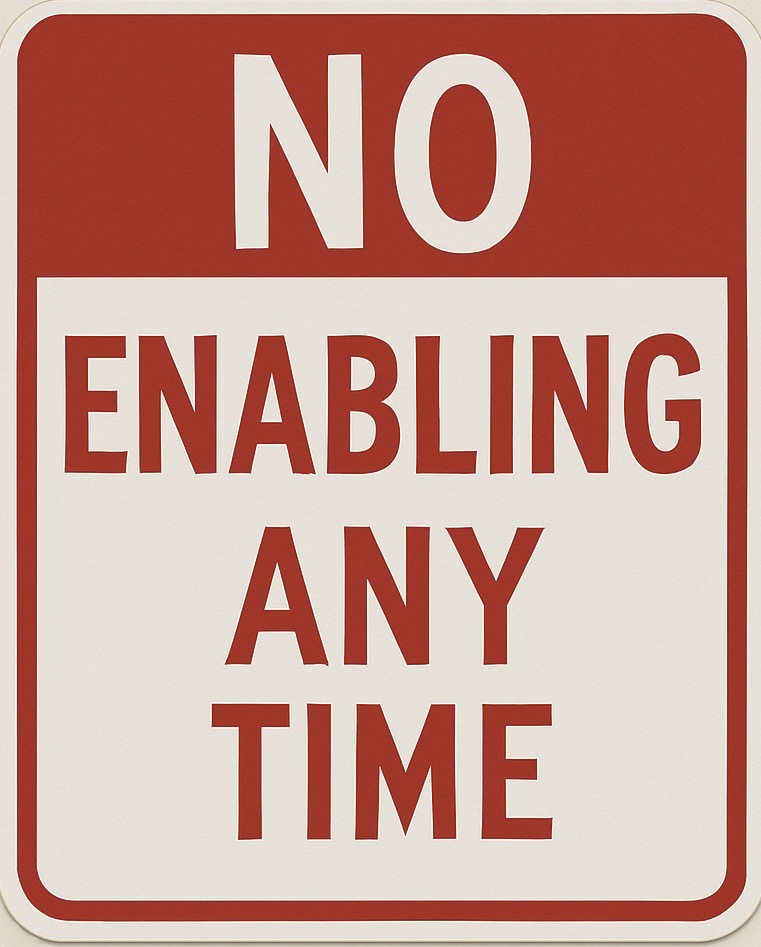

How to Hold a Boundary in the Moment When Your Loved One Catches You Off Guard
Learn how to hold a boundary in the moment when an addicted loved one asks for help unexpectedly — scripts, delay tactics, and how to recover if you cave.
Direct answer
How do I know if I am helping or enabling?
Helping supports responsibility, truth, treatment, and repair. Enabling protects addiction from consequences, usually through money, excuses, housing, secrecy, or emotional rescue.
Reviewed through Matt Brown's family intervention and coaching lens.
Open full answer →Why this is here
Families rarely need more pressure. They need clearer patterns, steadier boundaries, and a next step they can actually hold.
Written from intervention experience
This article is part of No More Enabling’s family education library, shaped by Matt Brown’s work with families affected by addiction, treatment resistance, relapse, and boundary breakdowns since 2004.
Author and editorial reviewer: Matt Brown, professional interventionist and family addiction coach. Medical claims require separate qualified clinical review.
Read this as part of a bigger pattern
If this article hits home, these guided hubs will help you keep reading in a smarter order instead of starting from scratch each time.
Adult Child Addiction Hub
Best when you are asking how to stay loving without becoming the safety net for active addiction.
Open hub →
Financial Enabling Hub
Best when you need to help without becoming the financial safety net that keeps the addiction cycle alive.
Open hub →
Treatment Resistance Hub
Best when conversations about treatment keep failing and the family needs a calmer, more structured next move.
Open hub →
If this article sounds like your family
Do this next
If the real issue is holding the line, don’t stop at reading. Work through the boundaries course next.
Next best step
Choose your next step
If this article sounds like your family, use the short assessment to route the situation before the next hard conversation.
When your family needs a real plan
Coaching and intervention guidance with Matt Brown
If articles are helping but the situation at home is still escalating, you can ask for direct help with family alignment, boundaries, treatment refusal, relapse patterns, or deciding whether an intervention makes sense.
High-intent next step
Family addiction coaching with Matt Brown for enabling and boundaries
Get private family addiction coaching from Matt Brown for enabling, boundaries, treatment refusal, relapse, money decisions, and a clear next step.

You had it figured out. You knew exactly what you were going to say the next time your son asked for rent money, or your brother showed up at 11 p.m. needing a place to sleep. You'd rehearsed it.
Then the call came at a moment you didn't expect, in a tone you weren't braced for, and every word you'd practiced went straight out of your head. Learning how to hold a boundary in the moment is different from deciding what your boundary should be. Deciding happens in a quiet room. Holding happens in the middle of a crisis, when someone you love is upset and you are the only thing standing between them and what they want.
If you've caved in one of those moments, you're not weak and you're not back at square one. You were ambushed. This article is about what to do so the next ambush goes differently.
Why the Unplanned Moment Is So Much Harder
The unplanned ask removes the two things that make a boundary holdable: time and calm. When you're caught off guard, your body wants the discomfort to stop. Saying yes stops it fastest.
There's also a pattern most families never name out loud. Requests rarely come at neutral times. They come late at night, during a holiday, after a fight, or right when you're already exhausted. That isn't always calculated. Addiction runs on urgency, and urgency finds the moments when your resistance is lowest.
Two more things stack the deck against you:
- The ask usually arrives with a story attached — an eviction, a job, a court date, a car that won't start. The story is designed, consciously or not, to make no feel unreasonable.
- You are being asked to decide right now. Urgency is the pressure. Remove the urgency and the pressure drops by half.
None of this means your loved one is a villain. It means the moment is structured against you. You need a plan that works when you're rattled, not just when you're clear. If you haven't yet decided which limits matter most, start with preparing to set boundaries with an addicted loved one.
What Do You Say When You Don't Know What to Say?
You don't need the perfect answer. You need a sentence that buys you time. The most useful skill in holding a boundary in the moment is the pause — a short, honest phrase that ends the conversation without ending the relationship. Keep two or three of these ready:
- "I'm not going to decide that right now. I'll call you tomorrow."
- "I can hear this is urgent for you. It's still a no from me tonight."
- "I love you. I'm not doing that."
- "I need to think. I'm hanging up now, and I'm not angry."
Notice what's missing: explanation. The longer your answer, the more surface area there is to argue with. When you give five reasons, you've handed over five things to dismantle. A boundary doesn't require a defense. It requires a sentence and the willingness to stop talking after it. For more on what to say when setting limits with an addicted loved one, our examples guide gives you language you can borrow word for word.
Also notice what's present: warmth. You can be completely immovable and completely kind at the same time. Those aren't opposites, even though in your family they may have felt like it for years.
How Do You Buy Yourself Time Without Sounding Cold?
Delay is not avoidance. It's the single most effective tool families have for holding limits with an addicted loved one, because almost nothing presented as an emergency actually requires an answer in the next ten minutes. Before you respond to any unexpected request, run these three steps:
- Name the delay out loud. "I'm not answering that tonight." You are not stalling in secret; you're telling them the timeline.
- Physically change the situation. End the call, step outside, go into another room. Proximity to distress erodes resolve. Distance restores it.
- Talk to one other person before you decide. A spouse, a sponsor, a friend in Al-Anon, a coach. Say the request out loud to someone who isn't inside the emotion.
Nine times out of ten, twelve hours of distance will show you what the request actually was. The crisis that felt life-or-death at 11 p.m. often looks like a familiar pattern by 9 a.m. If you're worried delay sounds cold, say the warm part too: "I'm not deciding tonight, and I'm not going anywhere. We'll talk tomorrow."
What If You Already Caved?
You go back and repair it. Caving is a detour, not a verdict on your character. The families who get their footing aren't the ones who never slip — they're the ones who name the slip quickly and reset without weeks of shame first. A reset conversation takes about ninety seconds:
- Own it plainly. "I told you I wouldn't cover your phone bill, and then I did."
- Restate the limit. "That was the last time. I'm not paying it going forward."
- Stop. Don't apologize for the boundary, don't over-explain the reversal, and don't ask them to agree with you.
Then look honestly at what happened. Was it the hour? The tone? Being in the same room? Most people cave in a predictable spot. Once you know yours, you can prepare for it — you stop answering the phone after 9 p.m., or you make it a rule that any request involving money waits until morning. That isn't rigidity. That's engineering your environment so your best decisions become the easy ones. If guilt is the thing that pulls you back, read why guilt shows up after you hold a boundary.
Practicing Before You Need It
Boundaries fail under pressure for the same reason anything fails under pressure: they were never practiced under pressure. Three things make the next moment easier:
- Write your three sentences down and keep them in your phone. When you're flooded, you will not compose new language. You'll read.
- Rehearse out loud with another person. Have someone play the hard version — the crying, the anger, the guilt trip — so the real thing isn't the first time you've heard it.
- Decide in advance what is never up for discussion. Fewer decisions in the moment means fewer chances to be talked out of one.
Over time, something shifts. The ask still comes, but it doesn't knock you sideways. That's not coldness. That's a person who has stopped negotiating with their own limits. Expect testing along the way — here's what happens when an addict tests your boundaries.
You're Not Behind
If you've been reading this thinking about a specific moment you handled badly, let that go. You were loving someone in a situation you were never trained for, and you did what made sense at the time. Now you know a little more.
Start with one sentence. Put it in your phone tonight. The next time the unexpected ask comes, you won't have to invent an answer — you'll just have to read one out loud and mean it. Small things held steadily are what actually change families.
Frequently Asked Questions
How do I hold a boundary in the moment when I'm being yelled at?
Shorten your response and end the conversation. Say one sentence — "I'm not discussing this while we're yelling" — and physically leave or hang up. You are not obligated to stay present for escalation, and staying rarely changes the outcome. Re-engage when things are calm.
Is it okay to say no without giving a reason?
Yes. A boundary is a statement about what you will do, not a proposal that requires approval. Giving reasons invites debate, and a debate almost always goes to the person with more urgency. "That's not something I'm doing" is a complete answer.
What if it's a real emergency?
Genuine safety emergencies — overdose, medical crisis, immediate danger — call for immediate action, and you should take it. The distinction is between a threat to life and a threat to comfort or consequences. Money, rides, bail, and lying to employers are not safety emergencies, even when they're presented that way.
Will delaying make my loved one worse?
Delaying your answer doesn't cause addiction to progress; it removes your participation in the urgency cycle. What often happens instead is that your loved one solves the problem themselves, or the problem turns out to be smaller than described. Both outcomes are more useful than a rushed yes.
Get Support
If you're trying to hold limits with someone you love and keep getting caught off guard, you don't have to figure out the language alone. SoberHelpline.com offers family coaching for setting boundaries and education built for exactly these moments.
And if the situation has moved past what boundaries alone can address, FreedomInterventions.com can walk you through when boundaries aren't enough: professional intervention and whether it's the right next step for your family.
Free family tool
Financial Boundaries Script
A short script for saying no to cash, rent, bills, and last-minute rescue requests without getting pulled into another negotiation.
This does not replace the Family Squares meeting. It gives you a practical tool first, then points you toward the live support room if you need help using it.
Get weekly guidance for families dealing with boundaries
Every Sunday, one short email with practical family guidance on boundaries, enabling, relapse, and next steps.
"Practical, not preachy. It reads like someone who has actually sat with families instead of a wellness blog."
— Sister of a brother in relapse
Trust signals
Source-worthy public resources
These links are not a substitute for medical, legal, or crisis care. They are included to help families verify safety and treatment information from official sources.
Next best answers
If this is what you were really asking
How do I stop enabling without abandoning someone I love?
Stop doing what protects the addiction, but stay available for recovery-supporting action. The goal is not less love. The goal is cleaner support.
Open answer →
What if the other house is running a different plan?
Two houses. One disease. If one parent pays rent and the other hands over the keys, nothing holds. Money, housing, and contact have to be the same line in both kitchens. You cannot control the other house. You can stop being the second rescue.
Open answer →
How do I know if I am helping or enabling?
Helping supports responsibility, truth, treatment, and repair. Enabling protects addiction from consequences, usually through money, excuses, housing, secrecy, or emotional rescue.
Open answer →
What should I do when an addicted loved one breaks a boundary?
Do not renegotiate the boundary in the heat of the moment. Follow through calmly, document the pattern, and review whether the boundary was specific enough to hold.
Open answer →
Need a steadier next step?
Don’t stop at insight
The families who make progress usually do three things: they get honest about the pattern, choose one clearer next step, and stop trying to manage everything at once.
Helping or Enabling? Tool
Best when you keep second-guessing what support should look like.
Family Support Guide
Best when everything feels heavy, urgent, or emotionally scrambled.
Free Boundaries Course
Best when your limits keep getting negotiated away under pressure.
About Matt Brown and this site
Understand the experience and point of view behind the guidance here.

FamilyBridge
AI support for families across the recovery journey.