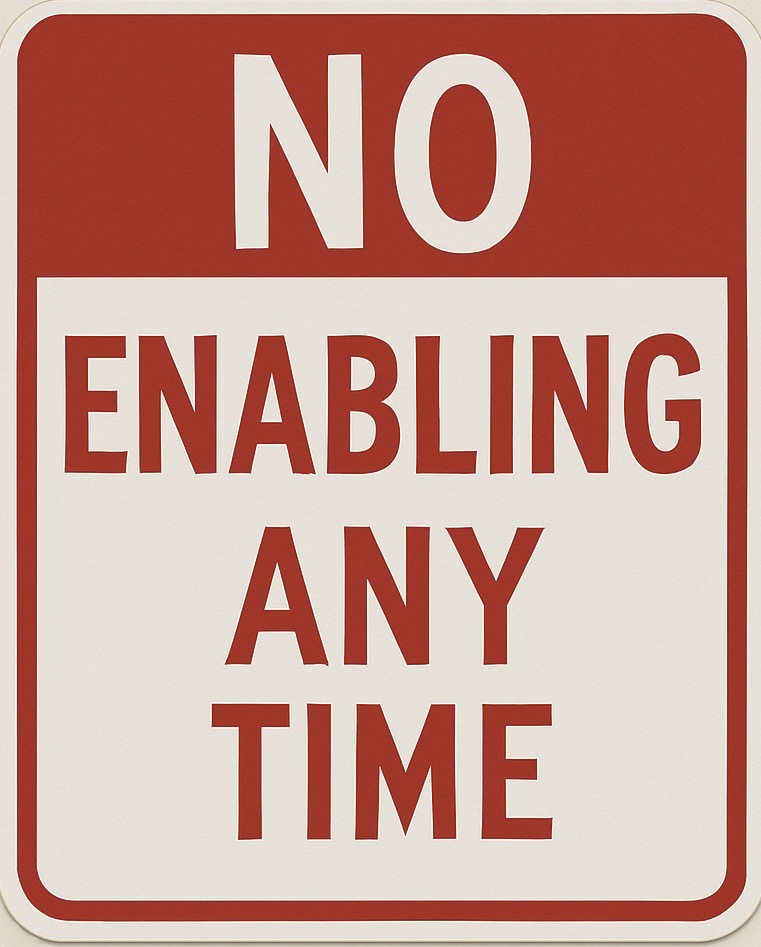

When Helping Starts Hurting: How Good Intentions Quietly Fuel Addiction
Most families don't realize they're enabling addiction because what they're doing looks like love, loyalty, and responsibility. This article explains how good intentions can unintentionally keep addiction alive.
Direct answer
How do I know if I am helping or enabling?
Helping supports responsibility, truth, treatment, and repair. Enabling protects addiction from consequences, usually through money, excuses, housing, secrecy, or emotional rescue.
Reviewed through Matt Brown's family intervention and coaching lens.
Open full answer →Why this is here
Families rarely need more pressure. They need clearer patterns, steadier boundaries, and a next step they can actually hold.
Written from intervention experience
This article is part of No More Enabling’s family education library, shaped by Matt Brown’s work with families affected by addiction, treatment resistance, relapse, and boundary breakdowns since 2004.
Author and editorial reviewer: Matt Brown, professional interventionist and family addiction coach. Medical claims require separate qualified clinical review.
Related next step
Ask for a family addiction consultation
If helping has started hurting and you are unsure what to do next, use this consultation path.
Open the next-step pageRead this as part of a bigger pattern
If this article hits home, these guided hubs will help you keep reading in a smarter order instead of starting from scratch each time.
Enabling Hub
Best when you keep wondering whether your support is helping or making the pattern worse.
Open hub →
Boundaries Hub
Best when your loved one keeps crossing lines and you are tired of repeating yourself.
Open hub →
Codependency Hub
Best when exhaustion, guilt, hypervigilance, and over-functioning have become normal.
Open hub →
If this article sounds like your family
Do this next
If the real issue is holding the line, don’t stop at reading. Work through the boundaries course next.
Next best step
Choose your next step
If this article sounds like your family, use the short assessment to route the situation before the next hard conversation.
When your family needs a real plan
Coaching and intervention guidance with Matt Brown
If articles are helping but the situation at home is still escalating, you can ask for direct help with family alignment, boundaries, treatment refusal, relapse patterns, or deciding whether an intervention makes sense.
High-intent next step
Family addiction coaching with Matt Brown for enabling and boundaries
Get private family addiction coaching from Matt Brown for enabling, boundaries, treatment refusal, relapse, money decisions, and a clear next step.
Most families don't realize they're enabling addiction because what they're doing looks like love, loyalty, and responsibility. This article explains how good intentions can unintentionally keep addiction alive—and how clarity, boundaries, and personal accountability create the conditions for real change.
Why Enabling Rarely Looks Like the Problem
When people hear the word "enabling," they often imagine reckless behavior or total denial. In reality, enabling usually looks responsible, caring, and self-sacrificing.
It sounds like:
"I'm just trying to keep things from getting worse."
"They can't handle the consequences right now."
"If I don't help, who will?"
"This is just temporary."
Enabling is rarely about approval. It's about protection—protection from discomfort, conflict, or fear of loss.
The Emotional Contract Families Don't Realize They've Signed
In many families affected by addiction, an unspoken agreement forms:
"I will absorb the stress so you don't have to change."
This contract is not conscious, and it is not malicious. It emerges when families prioritize short-term stability over long-term health.
Over time, this agreement leads to:
- Chronic resentment
- Emotional burnout
- Confusion about responsibility
- Increasing dependence on the family system
Addiction benefits from this arrangement. Families pay the price.
Codependency Is About Focus, Not Fault
Codependency is often misunderstood as weakness or neediness. In reality, it's about misplaced focus.
Instead of focusing on:
- Personal values
- Emotional limits
- Sustainable behavior
Families become consumed with:
- Monitoring someone else's choices
- Managing outcomes they can't control
- Preventing consequences at all costs
The more attention goes toward controlling the addiction, the less energy remains for self-respect, stability, and clarity.
This isn't a moral failing. It's a survival response that eventually becomes unsustainable.
How "Helping" Keeps Addiction Comfortable
Helping becomes enabling when it consistently reduces the pressure to change.
Common examples include:
- Paying bills tied to substance use
- Providing housing without expectations
- Covering up legal or workplace consequences
- Repeatedly rescuing after broken agreements
Each act may feel small in isolation. Together, they form a system that cushions addiction from reality.
Addiction does not require encouragement. It only requires enough comfort to continue.
Why Families Stay Stuck in False Hope
False hope is not optimism—it's avoidance disguised as patience.
It sounds like:
"This time feels different."
"They promised it would stop."
"Things aren't perfect, but they're better."
False hope keeps families emotionally invested without requiring structural change. It delays hard decisions while preserving the illusion of progress.
Hope becomes helpful when it's paired with action. Without action, it becomes a trap.
Free family email course
Free 4-week Boundaries email course
One lesson a week — the exact language, scripts, and family agreements that hold up when your loved one pushes back.
- Week 1 — What a real boundary actually is (and is not)
- Week 2 — Naming the boundary without threats or ultimatums
- Week 3 — Holding the line when they test it
- Week 4 — Getting your family on the same page
"Practical, not preachy. It reads like someone who has actually sat with families instead of a wellness blog."
— Sister of a brother in relapse
Boundaries Are Not Punishment
One of the biggest misconceptions families have is that boundaries are punitive or cruel.
Boundaries are not about controlling someone else's behavior. They are about clarifying your own.
Healthy boundaries:
- Define what you will and won't participate in
- Protect your emotional and financial stability
- Reduce resentment
- Create consistency
Boundaries do not guarantee change—but they remove confusion. And clarity is often the first thing addiction cannot tolerate.
Taking Responsibility Without Taking Blame
Families often ask, "If we change, does that mean this was our fault?"
No.
Responsibility is about influence, not blame.
You didn't cause the addiction.
You can't control the outcome.
But you do have influence over what you participate in going forward.
Taking responsibility for your behavior is not abandonment—it's alignment with reality.
Why Professional Perspective Matters Here
Breaking enabling patterns is difficult because they are emotionally reinforced.
Professionals who work with families understand:
- Why good people stay stuck
- How fear disguises itself as care
- Where boundaries collapse under pressure
- How to introduce accountability without cruelty
Outside perspective helps families see what they cannot see from inside the system.
This isn't about judgment. It's about clarity.
The Cost of Not Changing
Enabling doesn't just affect the person struggling with addiction—it reshapes the lives of everyone involved.
Over time, families may lose:
- Emotional safety
- Financial stability
- Trust in themselves
- Connection with others
Avoiding discomfort today often guarantees greater pain later.
A More Honest Way Forward
You don't have to stop caring to stop enabling.
You don't have to become cold to become clear.
And you don't have to wait for permission to change your own behavior.
Breaking codependency is not about forcing recovery. It's about reclaiming your integrity, your limits, and your life.
Clarity is not cruel. It's corrective.
Get weekly guidance for families dealing with enabling
Every Sunday, one short email with practical family guidance on boundaries, enabling, relapse, and next steps.
"Practical, not preachy. It reads like someone who has actually sat with families instead of a wellness blog."
— Sister of a brother in relapse
Trust signals
Source-worthy public resources
These links are not a substitute for medical, legal, or crisis care. They are included to help families verify safety and treatment information from official sources.
Next best answers
If this is what you were really asking
How do I know if I am helping or enabling?
Helping supports responsibility, truth, treatment, and repair. Enabling protects addiction from consequences, usually through money, excuses, housing, secrecy, or emotional rescue.
Open answer →
What is codependency in addiction families?
Codependency is the pattern where a family member becomes over-responsible for another person's addiction, emotions, consequences, or recovery.
Open answer →
What if the other house is running a different plan?
Two houses. One disease. If one parent pays rent and the other hands over the keys, nothing holds. Money, housing, and contact have to be the same line in both kitchens. You cannot control the other house. You can stop being the second rescue.
Open answer →
How do I stop enabling without abandoning someone I love?
Stop doing what protects the addiction, but stay available for recovery-supporting action. The goal is not less love. The goal is cleaner support.
Open answer →
Need a steadier next step?
Don’t stop at insight
The families who make progress usually do three things: they get honest about the pattern, choose one clearer next step, and stop trying to manage everything at once.
Helping or Enabling? Tool
Best when you keep second-guessing what support should look like.
Family Support Guide
Best when everything feels heavy, urgent, or emotionally scrambled.
Free Boundaries Course
Best when your limits keep getting negotiated away under pressure.
About Matt Brown and this site
Understand the experience and point of view behind the guidance here.

FamilyBridge
AI support for families across the recovery journey.